
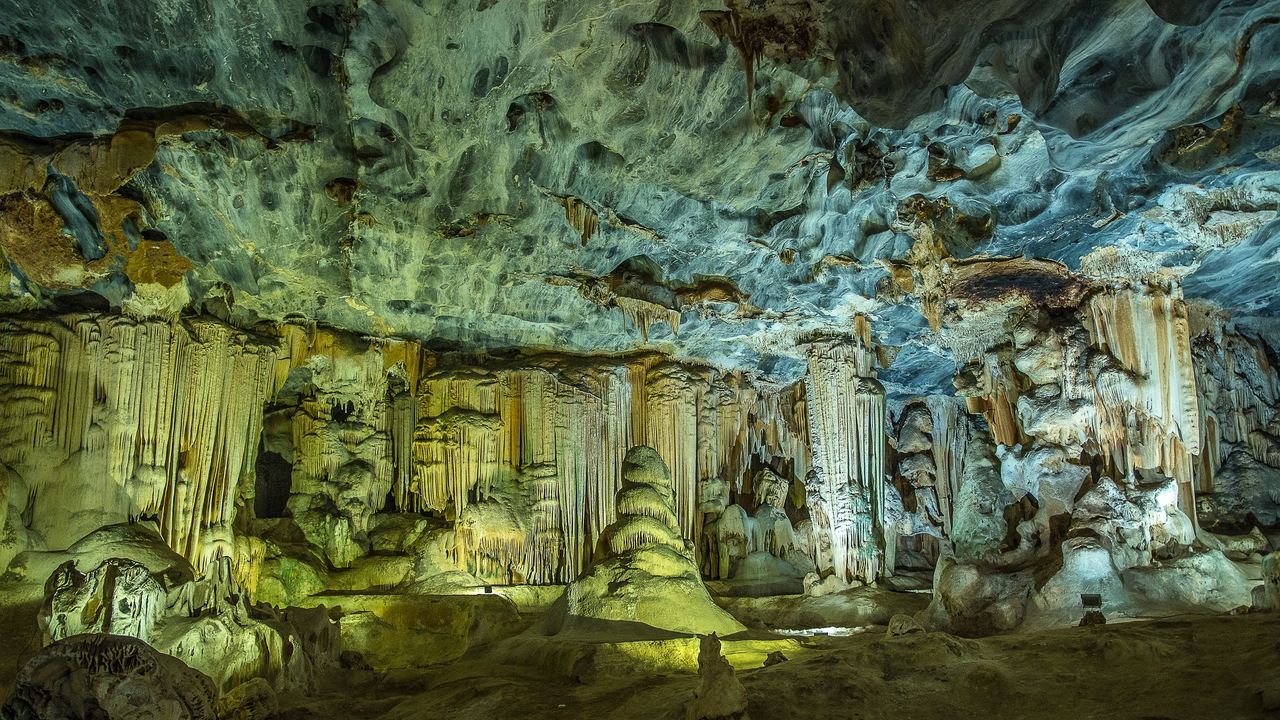
A speleothem is a mineral deposit named for how it looks in a cave, not for what it is made of. The National Park Service puts it with one example: calcite is not a speleothem, but a calcite stalactite is, and a stalactite may be made of halite or gypsum instead. That single sentence explains why cave vocabulary feels slippery. Most of the words describe a shape or a situation. Very few describe a substance.
This glossary is sorted by what you see on a tour: the ceiling, the floor and walls, the water, the ground above the cave, and then the words that show up on booking pages. A table at the end lists every term from A to Z. Definitions come from the NPS pages on speleothems and karst, the USGS Glossary of Karst Terminology (Water-Supply Paper 1899-K), the International Show Caves Association and the Škocjan Caves Park, all read on 19 October 2026. Where two sources disagree, or a word has no official meaning, the entry says so. For the bigger picture of how a cave comes to exist, start with our guide to how caves form.
Stalactite or stalagmite: how do you tell them apart?
A stalactite hangs from the ceiling. A stalagmite rises from the floor. The NPS gives the Greek behind the first word: stalactite means "oozing out in drops". The USGS glossary gives the second, a Greek word for "drip". Every stalactite, whatever it is made of, begins as a hollow soda straw, a thin tube with a drop of water hanging at the tip. Stalagmites have no central tube. Water drops splash when they land, so a stalagmite spreads out as it builds up from the floor. The NPS compares stalactites to icicles or carrots.
The mnemonic everyone repeats says stalactites hold tight to the ceiling and stalagmites might reach it. It is a classroom trick, and it stops working the moment a guide points at a thick pillar that runs floor to ceiling. That pillar is neither. As the NPS puts it, "columns are not stalactites nor are they stalagmites; they are both, together". It adds that columns can pass 20 m in height and diameter.
The quick test: look for the hole. A hollow tube at the centre of something hanging from the ceiling means stalactite. A solid, spreading base on the floor means stalagmite. A single piece that joins both means column.

Why size tells you so little about age
The tempting rule is that a bigger formation is an older one. The NPS tells visitors to Great Basin National Park the opposite can be true: the largest column in a cave may be younger than a two-inch soda straw, because hollow straws grow longer and faster than wide formations, and growth rates depend on how much calcite is in the water and how fast it drips.
There is no single growth rate to quote. A stalactite or stalagmite gains roughly one cubic inch per 100 years on average, says the NPS at Cumberland Gap, which works out to about 2,800 years for a 12-inch cone that is 3 inches across at the base. That is a volume estimate for one cave, not a speed limit for all of them. The NPS Great Basin reports that uranium-thorium dating put the oldest samples from Lehman Caves at about 2.2 million years.
What else hangs from the ceiling?
Soda straw. A thin-walled tube of nearly uniform diameter hanging from a ceiling or ledge (NPS Great Basin). It is the first stage of a stalactite, and as long as it stays hollow it can grow faster than the thick forms around it.
Drapery. A curtain-like sheet of calcite. It forms where water runs down a sloped ceiling before it drips, so the calcite builds up along a line. When the layers carry stripes of iron oxide or organic colour, the NPS notes, the formation is called cave bacon, because it looks like it.
Helictite. A speleothem that twists in any direction, seemingly against gravity. The name comes from the Greek for a spiral. The NPS explains that every helictite has a tiny central channel, and capillary water seeping through it feeds the tips, which is how they grow in odd directions. The same page quotes an older description of them as "the horrible, snaky tresses of Medusa".
Coralloid, or cave popcorn. A catch-all word for knobby, nodular or coral-like deposits. After stalactites, stalagmites and flowstone, the NPS says, coralloids are probably the most common type. Frostwork is the needle-like growth that often radiates from popcorn nodules, and the NPS counts it among the most fragile of all speleothems.
What builds up on the floor and the walls?
Flowstone is calcite or another carbonate deposited in layers where water flows over a wall or floor. The NPS says it has been described as "melted cake icing" and "frozen waterfalls", and calls it one of the most common speleothems. Rimstone is the same process with a dam: the USGS defines a rimstone barrier (also called a gour) as a wall-shaped deposit that holds back a pool of water, and the pool behind it is a rimstone pool.
Cave pearls are concentrically banded concretions that form in shallow pools under dripping water, and they are not pearls. According to the NPS they can be round, cylindrical, irregular, cubical or even hexagonal, and range from smaller than a grain of sand to eight inches (20 cm) across. Moonmilk is a soft, white deposit of very fine crystals. Wet, it looks and feels like cream cheese, and dry it resembles talcum powder. The NPS adds that for centuries people used it as medicine, as a poultice to stop bleeding and as an antacid.
Breakdown is the heap of rock that has fallen from the walls and ceiling (USGS). A chockstone is a rock wedged between the walls of a passage. Neither is decoration, and both explain why some routes need a helmet and others do not.

Why guides ask you not to touch
The NPS explains the rule at Carlsbad Caverns in plain chemistry. Everyone has oil on their skin, and sunscreen and lotion add more. That oil stains the formation, dust settles on it, and the stain darkens. Skin oils also waterproof a formation so that it stops growing. A guide who tells you to keep your hands off is protecting something that cannot repair itself on a human timescale. The same logic applies to flash and tripods, which is covered in our page on photography rules in caves.
Which words describe water in a cave?
Sinking stream, swallow hole, ponor. A sinking creek is a stream that disappears underground. The place where it goes is a swallow hole, or in the Slavic-derived word the USGS lists, a ponor: a hole in the bottom or side of a closed depression through which water passes to or from an underground channel. At Škocjan in Slovenia the Reka River gathers on impermeable rock, then sinks into the caves. The park says its average flow before it goes underground is 8.95 cubic metres per second, rising to 387 during heavy floods, and that in the cave the water usually rises up to 30 m after heavy rain. The highest rise recorded is 132 m. The same river surfaces again in Italy, about 35 km away, at the Timava springs.
Resurgence and spring. A spring is any natural discharge of water onto the surface. A resurgence, in the European usage the USGS records, is the reappearance of a stream that sank earlier upstream. An estavelle is rarer, and worth knowing if you plan a trip in the wet months: it is an opening that acts as a swallow hole in one season and as a spring in another, depending on groundwater conditions. See caves in the rainy season for what that means for visits.
Siphon, sump and water trap. The USGS defines a siphon as a passage where the ceiling dips below the water surface, and a water trap as a place where the roof dips under water and lifts again farther on. By definition the passage continues underwater, which is why a dry tour stops there and divers carry on. Sump is less tidy. The USGS gives it two meanings: a water trap, or a pool of underground water whose submerged extension has not been explored. Cave writers use the word both ways.
Cenote. A flooded sinkhole where the limestone bedrock has collapsed. It has its own page, Cenotes Explained, and a set of cenote tours around Tulum.
What do karst, doline and uvala mean?
These words describe the ground above the cave, and the first two come from one place. According to the UNESCO listing for the Škocjan Caves, the area is where "karst" and "doline" have their origin. The USGS traces karst to a German form of a Slavic word, kras, meaning a bleak, waterless place. The glossary adds that it is the German name for a district east of Trieste with that kind of terrain. Karst is terrain underlain by limestone where the topography is mostly formed by dissolving rock, usually with closed depressions, underground drainage and caves.
A doline is a basin- or funnel-shaped hollow in limestone. The USGS gives a range of a few metres to a kilometre across, and from a few to several hundred metres deep. Several dolines that merge make an uvala (a compound doline), and a very large flat-floored depression several kilometres long is a polje. Sinkhole is the general American word for these closed depressions. The NPS defines it as a depression formed when the land surface sinks because bedrock dissolves or a cave collapses. A blind valley is one that ends suddenly where its stream goes underground.

What do show cave, wild cave and cavern mean on a booking page?
The International Show Caves Association defines a show cave as "a natural occurring void beneath the surface of the earth that has been made accessible to the public for tours". Notice what the sentence leaves out. It says nothing about lights, paths or handrails, so the label tells you a cave is open for guided visits and nothing about how you will move through it. The listing has to answer that. Our page on types of cave tours sorts the formats.
Wild cave has no standard definition in the sources we read. In listings it generally means a cave without a built route, which is why the equipment line matters more than the title.
Cavern is a word with two lives. The USGS glossary calls it "a cave, often used poetically or to connote larger-than-average size". Scuba training uses it differently, for a zone near an entrance with its own rules, and the training agencies do not draw it in the same place. We have not found a primary text that fixes the divers' definition, so this page does not quote one.
Three words help anyone worried about tight spaces, and all three are in the USGS glossary. A crawl is a passage you must negotiate on hands and knees. A flattener is wide but so low that you can only move lying down. A squeeze is a passage "just passable with effort", with little spare space in any direction. Search a listing for those three before you book, and read cave tours for claustrophobic visitors if the thought bothers you.
Which words describe what lives in the dark?
The USGS defines a troglobite as an animal that lives permanently underground in the dark zone and only accidentally leaves it. The NPS at Mammoth Cave adds that troglobites cannot survive on the surface or travel between cave systems, and that they are typically endemic to a single cave or system. A troglophile habitually enters the dark zone but spends part of its life outside, and a trogloxene enters a cave for various reasons without living there permanently.
Here the two federal sources disagree. The USGS glossary lists some bats as troglophiles. The NPS page for Mammoth Cave says bats and moths are trogloxenes. Neither is wrong in the way a typo is wrong. The categories are judgment calls about how much of a life a species spends underground, and a bat that roosts in a cave by day and feeds outside at night sits on the line.
Guano is accumulated dung in caves, mostly from bats, and in some places partly mineralised (USGS). The NPS at Great Basin points out that the nest material and droppings left by temporary visitors feed the troglobites, so in some caves guano is a main source of food for the permanent residents. The animals themselves, from glowworms to olms, are in cave wildlife.
Which words name the rock and the kind of cave?
Solution cave. The most common type, formed when rock dissolves along fractures, faults and layers. The NPS lists limestone, marble, dolomite, gypsum and halite as the usual rocks. UNESCO describes the Škocjan Caves in Slovenia as a system of limestone caves, which puts them in this type.
Lava tube. A tunnel left behind when a lava river forms a roof and then drains. The NPS says lava tubes are "probably" the second most common cave type, and the word probably is in the original. Sea cave is a cave formed mainly by wave erosion along weaknesses in the rock. If it opens at both ends it becomes an arch, and when the arch roof collapses it leaves a sea stack. Compare them in sea caves compared.
Ice cave has two meanings, and the NPS keeps them apart. A cave formed in ice by meltwater moving through a glacier is a glacier ice cave. A cave in rock that contains ice all year is an ice cave. A tour of an Icelandic glacier cave is the first kind. Read why ice caves come and go for why it matters.
Tuff and tufa are one letter apart and unrelated. Tuff is consolidated or cemented volcanic ash, according to the USGS thesaurus, and the NPS says it forms from ashfall or pyroclastic flows. Tufa is calcium carbonate deposited from water, a relative of travertine. The Pontifical Commission for Sacred Archaeology says Rome's catacombs were mostly excavated in tuff or other soils that are easy to remove but solid, which it calls "negative architecture". At least one tour operator's explainer we read calls Naples tuff a sedimentary limestone. That is wrong. See the Naples Underground tours and Rome catacombs pages, and our guide to underground cities, catacombs and mines. Read the commission's text on the Vatican site.
Finally, cave itself. The USGS defines it as a natural underground room or series of rooms large enough for a person to enter, generally formed by dissolving limestone. Great Basin National Park uses a narrower rule for its own caves: a natural opening in rock, accessible to a person, at least 30 feet long and with a dark zone, and the NPS presents that as the park's definition and not a general one. Two federal texts, two answers. Nobody has a single definition that every guidebook follows.
Cave glossary A to Z
| Term | Short definition | Where you meet it |
|---|---|---|
| Blind valley | A valley that ends where its stream sinks underground | Karst country above caves |
| Breakdown | Fallen rock from walls and ceiling | Piles beside the path |
| Cave bacon | A striped, layered drapery | Ceilings and sloping walls |
| Cave pearl | A banded concretion formed in a pool under drips | Shallow pools |
| Cavern | In general use a large cave; scuba training uses it differently | Booking pages, dive listings |
| Chockstone | A rock wedged between the walls of a passage | Narrow passages |
| Column | A stalactite and stalagmite joined | Floor to ceiling |
| Coralloid (popcorn) | Knobby, nodular deposit | Walls and ledges |
| Crawl | Passage taken on hands and knees | Adventure routes |
| Doline | Funnel- or basin-shaped hollow in limestone | The surface above a cave |
| Drapery | Curtain-like sheet of calcite | Sloped ceilings |
| Estavelle | An opening that is a spring in one season and a swallow hole in another | Karst rivers in the wet season |
| Flattener | Wide passage so low that you must lie down | Adventure routes |
| Flowstone | Layered deposit where water flows over rock | Walls and floors |
| Frostwork | Needle-like growth on other formations | Popcorn and stalactites |
| Glacier ice cave | A cave formed in glacier ice by meltwater | Glaciers, for example in Iceland |
| Guano | Accumulated bat dung | Floors of bat roosts |
| Helictite | A twisting speleothem fed by a tiny central channel | Ceilings and walls |
| Karst | Terrain shaped by dissolving rock | The region around a cave |
| Lava tube | Tunnel left when a lava river drains | Volcanic islands and fields |
| Moonmilk | Soft, white, fine-crystalled deposit | Walls |
| Ponor | Opening where water enters an underground channel | Where a river vanishes |
| Rimstone (gour) | Wall-shaped deposit that holds a pool | Terraced pools |
| Show cave | A natural void made accessible to the public for tours (ISCA) | Guided public caves |
| Siphon | Passage where the ceiling dips below water | The end of a dry route |
| Soda straw | Hollow tube of nearly uniform diameter | Ceilings |
| Speleothem | A cave mineral deposit named for its shape | Everywhere |
| Squeeze | Narrow passage passable with effort | Adventure routes |
| Stalactite | Deposit hanging from the ceiling, starting as a straw | Ceilings |
| Stalagmite | Deposit rising from the floor, no central tube | Floors |
| Sump | A water trap, or an unexplored submerged pool | Cave rivers |
| Troglobite | Animal living permanently in the dark zone | Cave streams and floors |
| Tuff | Cemented volcanic ash | Naples and Rome underground |
| Uvala | Compound doline formed by several merged dolines | The surface above a cave |
Pair this page with why caves are cool inside for the air, and how to choose a cave tour when you are ready to book.
Quick answers about cave words
Can I touch a stalactite?
No. The NPS says skin oils stain formations and waterproof them so that they stop growing. Some sites also forbid it in writing, so follow the rule posted at the entrance.
How fast do stalactites grow?
There is no single rate. The NPS at Cumberland Gap estimates about one cubic inch per 100 years for a stalactite or stalagmite, on average, and the NPS at Great Basin says rates vary with the calcite in the water and the drip rate.
Are cave pearls real pearls?
No. They are concentric layers of calcite or aragonite that build around a grain in a pool under dripping water. They got the name because of their lustre.
Is a catacomb a cave?
Not in the geological sense. Catacombs are dug by people, usually into soft rock such as tuff, while caves are natural. See underground cities, catacombs and mines.
If you book a tour through one of the links on this site, caves.travel earns a commission from the provider at no extra cost to you. It does not change what we write about a cave.
Data verified on . Definitions read on NPS, USGS, ISCA and Škocjan Caves Park pages on 19 Oct 2026. Where sources disagree, the entry says so.
See the formations in person
Postojna Cave has stalactites, columns and flowstone on a guided route.