
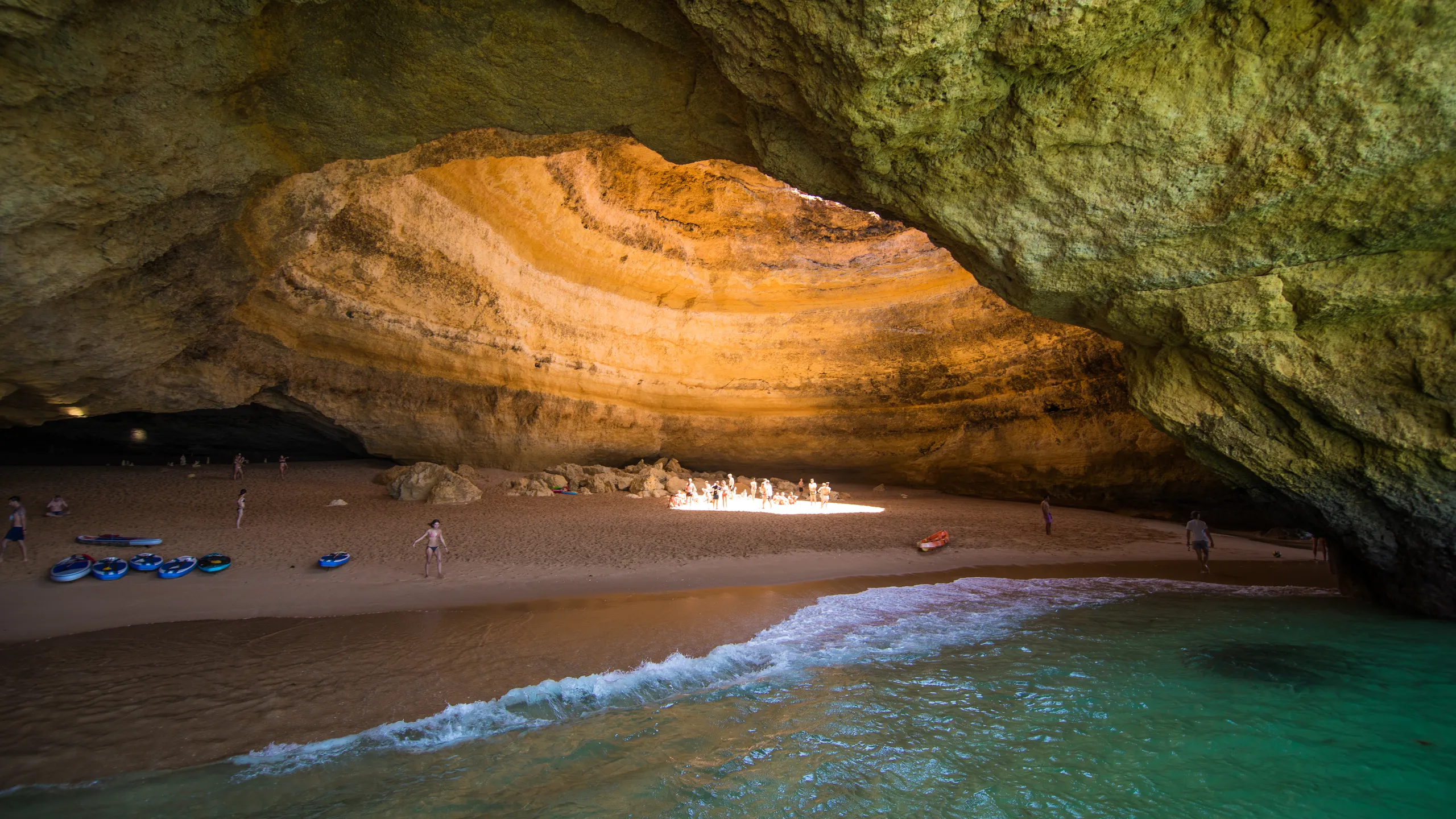
Choosing a cave tour starts with the body, not the cave. The questions that decide a day are physical: will you be wet, how many steps, do low ceilings bother you, can you carry a camera. Some of the answers are written down by the people who run the place. At Benagil a motorized boat may stay inside for 2 minutes. At Postojna the official path has no steps but one slope of 20 percent, about 200 meters long. At Wieliczka the tourist route has about 800 steps. This guide lines up 19 destinations on facts like these, and on nothing else.
Every cell in the tables below carries the name of its source or the words not confirmed. We read the cave's own site, a public body or a national tourism office on 19 October 2026. A page from the cave's own operator counts, and we say when that is what it is. Anything that came only from a tour listing is left out. Dimensions, step counts and rules change, so read the tables as a list of questions to ask, and check the site before you go. Prices, opening hours and the number of tours are not here on purpose, because they date quickly and the category pages already carry them.
Three questions sort most of the 19
Will you be in the water? The authorities have views of their own on this. Swimming into Benagil and bathing in Biševo's Blue Cave are both prohibited. Waitomo's Black Water Rafting, the river tubing at Nohoch Che'en and the cenotes around Tulum are built around water. Where the water is part of the visit, caves you visit by boat, swimming or tube covers the skills and the risks.
How many steps can you take? The numbers differ by an order of magnitude: none at Postojna, about 50 at San Callisto in Rome, 100 between the two levels of the Waitomo Glowworm Cave, 131 down and 112 up in Paris, 136 each way under Naples, about 800 at Wieliczka. Most sites that give a number give it for the tourist route only. Cave tours for limited mobility turns the numbers into a plan.
How do low, narrow and dark places feel to you? Some sites say it in plain words: Kaymaklı's passages are low, narrow and sloping, and San Callisto's rules say the visit is not recommended for people with claustrophobia. Others say nothing, and the tables say so. Cave tours for claustrophobic visitors has the questions to put to a site that stays silent.
Settle the one limit you cannot negotiate first. For most people it is water or stairs, and the official pages are more likely to answer the stairs question.
Sea caves: boat, kayak or rowing boat
Boat caves look interchangeable from the dock and are not. The Capri grotto is entered lying down in a rowing boat. Biševo is a small boat through a 1.5 by 2.4 meter opening. Benagil is the one where a maritime authority has published rules for the inside of the cave: where boats may enter, how many, for how long and in what gear.
| Place | How you move, and water contact | Steps and slope | Tight, low or dark | Cold, access and photos |
|---|---|---|---|---|
| Blue Cave, Biševo (Croatia) | Small boat. Bathing, swimming and diving in the cave are forbidden (Biševo code of conduct). | Not confirmed | Entrance 1.5 m high and 2.4 m wide, entered by small boat (Komiža tourist board). | Temperature and access: not confirmed. Commercial photography needs a permit from Sea and Karst; rules for visitors not confirmed (Biševo code of conduct). |
| Blue Cave off Dubrovnik (Koločep, Croatia) | Not confirmed: no official page found | Not confirmed | Not confirmed | Not confirmed |
| Blue Grotto, Capri (Italy) | Rowing boat; passengers lie down to pass the entrance (Comune di Anacapri). Swimming rules not confirmed. | Not confirmed | Entrance about 1 m high (Comune di Anacapri); Treccani gives 1.30 m. | Site stays closed in adverse sea conditions (Ministry of Culture). Wheelchair access and photo rules: not confirmed. |
| Benagil (Portugal) | Boat or kayak only. Landing on the beach inside, entering by swimming or with flotation aids, and diving are banned; life jackets compulsory (AMN Edital 019/2024). | Not confirmed | Helmets required near rockfall zones. Time inside capped at 2 minutes for motorized boats and 8 for kayak groups; no entry if visibility is under 1,000 m (AMN Edital 019/2024). | Kayak groups of six with one first-aid-certified guide (AMN Edital). Temperature, access and photos: not confirmed. |
| Ponta da Piedade (Portugal) | Not confirmed: only commercial listings found | Not confirmed | Not confirmed | Not confirmed |
Sources: the Komiža tourist board on the Blue Cave, the Biševo code of conduct, the Comune di Anacapri, the Ministry of Culture and Treccani for the Blue Grotto, and the Portuguese maritime authority's Edital 019/2024 for Benagil. Category pages: Blue Cave, Blue Cave from Dubrovnik, Capri, Benagil and Ponta da Piedade.
What closes a sea cave
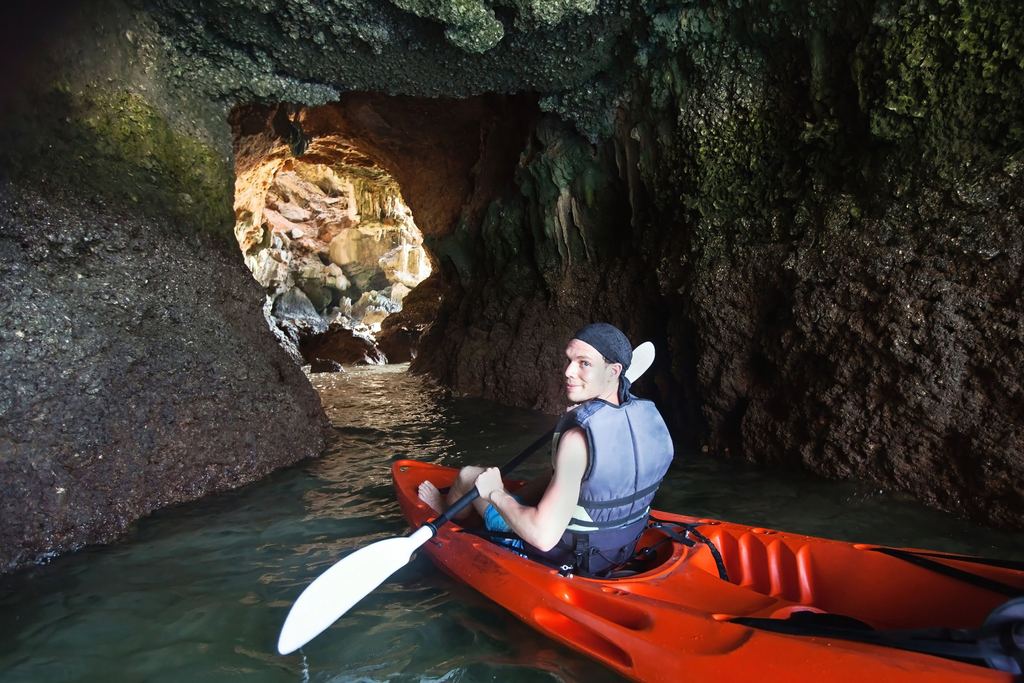
Two of these caves are shut by the weather on paper. The Ministry of Culture's page for the Blue Grotto says the site stays closed in adverse sea conditions. The Benagil edital makes visits conditional on weather and ocean conditions that allow them, bars access when visibility is under 1,000 meters, and lets a notice to mariners stop visits altogether. Biševo's official pages do not say. None of these sources gives a wave height or a wind speed, and we do not invent one.
In practice, a sea cave is open or closed by that morning's sea and not by the calendar. If your trip has a spare day, plan one. If your cave tour is canceled explains who decides, and sea caves compared sets the five side by side.
Show caves and river caves: walkways, trains and rowed boats
This group is the most uneven in what the official pages say. Postojna's site is precise down to the gradient. Waitomo's FAQ counts the stairs in the Glowworm Cave but gives no ceiling height. The Phong Nha national park page describes distances in meters and says nothing about stairs.
| Place | How you move, and water contact | Steps and slope | Tight, low or dark | Cold, access and photos |
|---|---|---|---|---|
| Postojna (Slovenia) | Part of the tour by train, then just over a kilometer on foot. No water contact described (Postojna Cave Park). | Path has no steps. One section about 200 m long rises about 40 m (a 20% incline), then a similar descent (Postojna Cave Park). | Not confirmed | 10 °C. Strollers fine; wheelchair users advised to do the train part only, with 2 days' notice. Photos allowed without flash or tripod (Postojna Cave Park). |
| Waitomo (New Zealand) | Glowworm Caves tour includes a boat, 23 people or fewer per boat. Black Water Rafting uses a wetsuit and a tube; swimming is not required but you must be comfortable in water (Waitomo operator FAQ). | Glowworm Cave: two levels 16 m apart with 100 stairs between them (Waitomo operator FAQ). | Not confirmed | Operator pages give 16 °C, 12 to 14 °C and about 15 °C. Glowworm Cave and Aranui need reasonable mobility, with handrails and paths and no wheelchair access; Ruakuri is wheelchair and pushchair friendly. Photography not permitted in the Glowworm Caves or on Black Water Rafting; cameras allowed in Ruakuri and Aranui (Waitomo operator pages). |
| Phong Nha Cave, by boat (Vietnam) | Motor boat about 30 minutes down the Son River, then engine off and rowed through about 1,200 m of underground river; up to 12 passengers a boat (Phong Nha-Ke Bang National Park). | Not confirmed | Not confirmed | Temperature, access and photos: not confirmed. |
| Paradise Cave, Phong Nha | On foot, dry cave: a 1.6 km path (walk or electric buggy), a 500 m trek to the entrance, then 1 km on a wooden walkway (Phong Nha-Ke Bang National Park). | Step count not given on the park page. | Chambers up to 150 m wide and 100 m high, according to the park. A separate 7 km adventure tour adds kayaking across an underground river and wading (park page). | Temperature, access and photos: not confirmed. |
| Dark Cave and Chay River, Phong Nha | Harness and life jackets, a 400 m zipline over the river to the cave entrance, then swimming and a mud bath (Phong Nha-Ke Bang National Park). | Not confirmed | Mud bath needs a height of 1.1 m or more; the zipline needs a weight over 40 kg (park page). | Not confirmed |
| Trang An, Ninh Binh (Vietnam) | Boat rowed by local people, life jacket requested. Four routes of roughly 1.5 to 3 hours through caves, one with a two-way passage (Ninh Binh tourism promotion center). | Not confirmed | Not confirmed: the page gives no ceiling height. | Temperature, access and photos: not confirmed. Tam Cốc: not confirmed. |
Sources: Postojna Cave Park and its mobility page; the Waitomo operator's FAQ and Ruakuri page; the national park pages for Phong Nha Cave, Paradise Cave and the Chay River and Dark Cave; and the Ninh Binh tourism promotion center. Category pages: Postojna, Waitomo, Phong Nha and Trang An and Tam Cốc.

Postojna: no steps, one real slope
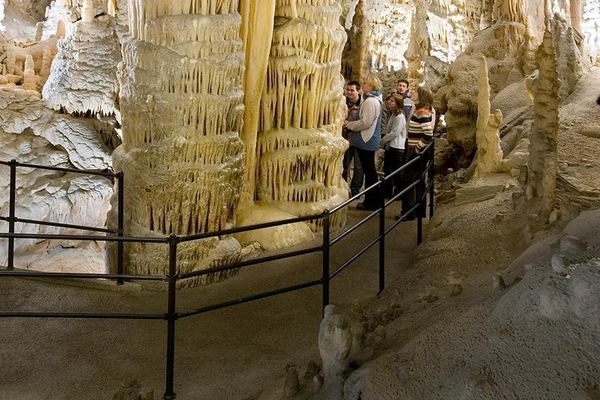
Postojna's mobility page is the most specific official statement in this guide. The path has a non-slip concrete surface and no steps. It does have one sloping section, about 200 meters long and rising about 40, followed by a similar descent. The park advises visitors who need a wheelchair or another person's help to tour the part done by cave train. They may do the whole tour if a companion can help them over the slope, and wheelchair users must give at least 2 days notice. The footpath is 1.2 km long.
Two details are easy to miss. The train boards 15 minutes before the tour time, and the park asks you to arrive 30 minutes before. And Predjama Castle, which is often sold alongside the cave, is not adapted: the park says it has many steps and is unsuitable for people with severe mobility problems and wheelchair users. The adventure tours in the less visited parts of the 24 km system need a good level of fitness and caving experience, according to the same page.
Water adventures: swim, float or dive
This is the group where the official pages say the least, which is itself a finding. The Belize heritage institute sells ATM tickets only through licensed operators and publishes little else about the cave, and no public body we found describes the Tulum cenotes. Treat the empty cells as reasons to ask the operator, in writing, before you pay.
| Place | How you move, and water contact | Steps and slope | Tight, low or dark | Cold, access and photos |
|---|---|---|---|---|
| ATM Cave (Belize) | Cave 3.13 miles long. Tickets sold only by licensed tour operators (NICH). Swimming and gear requirements: not confirmed on any official page we could open. | Not confirmed | Not confirmed | Not confirmed |
| Nohoch Che'en cave tubing (Belize) | River cave system along the Sibun River; visitors meander along peaceful waters, with up to four stops on trails (NICH). | Not confirmed | Not confirmed | Not confirmed |
| Cenotes near Tulum (Mexico) | Cenotes are flooded sinkholes formed by the collapse of limestone bedrock (Microbial Ecology, 2024). Dos Ojos describes guided cavern routes, with diving and snorkeling (Dos Ojos site). | Not confirmed | Dos Ojos: two main cavern routes; go with a qualified guide (Dos Ojos site). | Temperature, access and photos: not confirmed. |
Sources: the National Institute of Culture and History on ATM Cave, its ticketing page and Nohoch Che'en; the Dos Ojos site; and a peer-reviewed article for the cenote definition. Category pages: ATM Cave, Belize cave tubing and Tulum cenotes. For the risks, are cave tours safe? goes through them by mechanism.
Built underground: catacombs, cities, mines and tunnels
These places were dug by people, and their official pages are the most informative in the guide, because a museum or a council has to say how many steps there are. Why each was dug is on underground cities, catacombs and mines. Here is what they ask of you.
| Place | How you move, and water contact | Steps and slope | Tight, low or dark | Cold, access and photos |
|---|---|---|---|---|
| Paris Catacombs (France) | One-way walking circuit of 1.5 km; can be very humid (City of Paris). | 131 steps down and 112 up (City of Paris). | Not recommended for heart or respiratory conditions; children under 14 with an adult; 200 people at most on site (City of Paris leaflet). | 14 °C. Not accessible to wheelchair users. Bags up to 40 x 30 x 20 cm. Photos without flash or tripod (City of Paris). |
| Rome: San Callisto catacombs (Italy) | Guided only, in groups of at least two, about 30 to 40 minutes (San Callisto rules, in German). | About 50 irregular steps at entrance and exit; no seating on the route; no lift. | Not recommended for people with claustrophobia. | About 16 °C. Not accessible to wheelchairs or walkers. Filming and photography forbidden. |
| Naples Underground (Italy) | Guided walk of about an hour through damp underground spaces (Napoli Sotterranea FAQ). | 136 steps down and 136 up, no lift; one answer on the same FAQ says 121. | Large lit rooms; one short optional tunnel by candlelight, and visitors can wait outside (FAQ). | No temperature figure; the site says it monitors the microclimate. Not accessible to wheelchairs or walkers; strollers stay at the entrance (FAQ). Photos: not confirmed. |
| Naples: San Gennaro catacombs (Italy) | Two levels with walkways and ramps (catacombs site). | Not confirmed | Lower vestibule with ceilings up to 6 m high (catacombs site). | 15 to 22 °C. Step-free entrance temporarily closed when read; tactile plates for blind visitors by reservation (catacombs site). Photos: not confirmed. |
| Cappadocia: Derinkuyu and Kaymaklı (Turkey) | Walk through rock-cut floors; about 10 percent of Derinkuyu can be visited (culture ministry). | Not confirmed | Kaymaklı: passages low, narrow and sloping (culture ministry). Derinkuyu: not confirmed. | No figure; the ministry says cool in summer and warm in winter. Access and photos: not confirmed. |
| Cu Chi tunnels (Vietnam) | Visitors can crawl through tunnels (Vietnamese state portal). | Not confirmed | Not confirmed: no official dimensions found. | Not confirmed |
| Wieliczka tourist route (Poland) | Always with a guide; 3.5 km, 2 to 3 hours, groups of up to 40 (the mine). | About 800 steps, 380 of them at the start; down to 135 m (the mine). | Not confirmed. The mine says no exceptional fitness is needed. | 17 to 18 °C. Part of the route adapted for visitors who cannot walk independently, by email reservation, in Polish or English, in the first and last hour. Photography allowed; strollers discouraged (the mine). |
Sources: the City of Paris visit page, practical information and leaflet; the San Callisto visitor rules; the Napoli Sotterranea FAQ; the San Gennaro catacombs and their visit page; the culture ministry pages for Derinkuyu and Kaymaklı; the Vietnamese state portal; and the Wieliczka mine's information page and route page. Category pages: Paris, Rome, Naples, Cappadocia, Cu Chi and Wieliczka.
Where the official picture is least reliable
Accessibility is where official pages contradict themselves most. The San Gennaro catacombs call themselves the only site of their kind that is fully accessible, and the same page notes that the step-free entrance is temporarily closed. Napoli Sotterranea gives 136 steps in one answer and 121 in another. Waitomo's operator pages give three temperatures for the same caves. Derinkuyu is 85 meters deep on a ministry page and 50 on the district governor's.
Wieliczka's page needs a closer look. The visible text says part of the tourist route is adapted for visitors who cannot walk independently, with a reservation by email. The page's own data also carries an older notice, flagged hidden, saying that adapted tours were suspended for technical reasons. We followed the visible text, and a short email before you go would settle it.

Ice caves: reassessed every morning
Visit Iceland says glacier ice caves form in spring and summer, when meltwater carves outflow tunnels, and are ready to explore in autumn once temperatures drop below freezing, until the following spring. The season varies with temperature and weather and typically runs from November to May. It advises going only with professional glacier guides and the right equipment.
Vatnajökull National Park's board minutes of 30 September 2024 describe daily site assessments by the operators and the Association of Mountain Guides in Iceland, under a risk assessment the park made in 2017. A notice of 26 September 2024 called every ice formation under an ice roof, overhanging or arched, extremely dangerous at that time of year and prohibited access to ice caves until the end of October. For this guide that means nothing physical can be promised in advance: entry, steps, tightness and temperature are not confirmed, because they belong to the cave assessed that morning. See ice caves: when they exist and why and the Iceland ice cave tours page.
The answer, one limit at a time
The table uses only the attributes we could source above. If your limit is not here, it is probably in a row that says not confirmed, and the honest answer is to ask the site.
| If your limit is | Start with | Check twice |
|---|---|---|
| No stairs | Postojna, where the official path has no steps but one 20% slope | Wieliczka (about 800 steps), Paris (131 down, 112 up), Naples Underground (136 each way), the Waitomo Glowworm Cave (100 between levels), San Callisto (about 50); the San Gennaro step-free entrance was closed when read |
| You cannot get wet | Walking routes with no water contact described: Paris, San Callisto, Wieliczka, Postojna | Waitomo Black Water Rafting, Nohoch Che'en, the Tulum cenotes, the Dark Cave and Chay River in Phong Nha |
| Low or narrow spaces worry you | Naples Underground, whose only narrow tunnel is optional | Kaymaklı (low, narrow, sloping), San Callisto (not recommended for claustrophobia), Cu Chi (crawling), the Capri entrance (about 1 m, lying down), Biševo (1.5 m by 2.4 m) |
| You want to photograph | Wieliczka (allowed); Postojna and Paris (no flash or tripod) | San Callisto (forbidden), the Waitomo Glowworm Caves (not permitted), commercial work at Biševo (permit needed) |
| You use a wheelchair or walker | Postojna (train section, 2 days' notice); Ruakuri Cave at Waitomo; the Wieliczka adapted route (email reservation) | Paris, San Callisto, Naples Underground and the Waitomo Glowworm Cave and Aranui say they are not accessible to wheelchairs; check San Gennaro's step-free entrance before booking |
The category pages below carry the tours. Photo rules differ so much that photography in caves has its own page, and cave tours with kids and what to wear on a cave tour take the same attributes into the family and the wardrobe. Cave temperature explains the cold figures, types of cave tours the formats, and how to choose a cave tour the decisions that come after this one. The wider map is on where to go.
Caves with water, boats and ice
Twelve destinations where the water, the boat or the ice sets the terms.
Blue Cave, Biševo
Small boat; no swimming in the cave.
Blue Cave from Dubrovnik
Official attributes not confirmed.
Capri and the Blue Grotto
Rowing boat, entered lying down.
Benagil Cave tours
Boat or kayak; landing banned.
Ponta da Piedade
Official attributes not confirmed.
Waitomo glowworm caves
Boat in the Glowworm Caves; no photos there.
Phong Nha caves
Rowed river cave, a walkway cave and a swim-and-zipline cave.
Trang An and Tam Cốc
Rowed boats with life jackets.
ATM Cave
Licensed operators only.
Belize cave tubing
Floating along a river cave.
Tulum cenotes
Flooded sinkholes; guides advised for caverns.
Iceland ice caves
Reassessed daily by guides.
Caves you walk into
Seven places where the number of steps, the temperature and the access note are the useful facts.
Postojna Cave tours
No steps; one 20% slope.
Paris Catacombs
131 steps down, 112 up.
Rome catacombs
Guided only; about 50 irregular steps at San Callisto.
Naples underground
136 steps each way; one optional narrow tunnel.
Cappadocia underground cities
Kaymaklı: low, narrow, sloping.
Cu Chi tunnels
Crawling possible; dimensions not confirmed.
Wieliczka salt mine
About 800 steps; 17 to 18 °C.
Cave fit: quick answers
Which cave tours have no stairs?
Of the sites we could source, Postojna's official path has no steps, but one section about 200 meters long climbs at 20 percent. For boat caves the official pages we read do not describe boarding or steps, so ask the operator. The tables above give each site's own words.
Which caves forbid photography?
San Callisto in Rome forbids filming and photography, and the Waitomo Glowworm Caves do not permit it. Postojna and Paris allow photos without a flash or tripod, and Wieliczka allows photography. For the others the official pages we read are silent.
Are cave tours wheelchair accessible?
It depends on the site. Paris, San Callisto and Naples Underground say they are not accessible to wheelchairs or walkers, and the Waitomo Glowworm Cave has no wheelchair access. Postojna and Wieliczka describe adapted options with notice or a reservation, and Waitomo's Ruakuri Cave is wheelchair friendly. Read the mobility page before booking.
What does not confirmed mean in the tables?
It means we found no official page, or no statement on one, on 19 October 2026. It does not mean the answer is no. It means the question belongs in an email to the site before you pay.
If you book a tour from one of our category pages, caves.travel earns a commission at no extra cost to you. It does not change what is written above. Official ticket or guided tour says when the official ticket is enough.
Postojna tours
The cave in this guide whose official path has no steps.
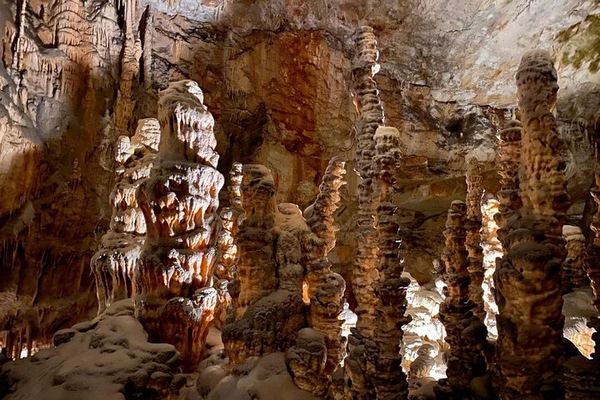
Day Trip to Postojna Cave and Predjama Castle With Water and WiFi From Ljubljana
Bottled water, WiFi and parking fees are covered on this Ljubljana trip for up to eight travelers, with entrance to the cave and castle booked separately.
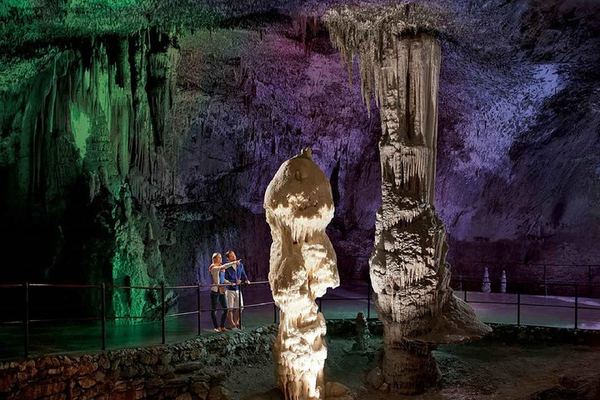
Deluxe Private Tour From Rovinj to Postojna Cave and Predjama Castle
A private driver and guide, insurance and a hotel or port pickup in Rovinj are included in this deluxe day out, with guiding in German, English or Italian.
Group Tour to Postojna Cave With Cave Train and Castle Photo Stop From Koper
Meet at the ISTRANKA TOURS kiosk by the cruise terminal exit in Koper for the cave train, a licensed guide, basic insurance and a photo stop at a cave castle.
Ratings collected by Viator and Tripadvisor
Pick the cave, then check the page
Every row above names where to look. Start with the cave that fits your first limit, and read its official page before you pay.
Data verified on . Read on each site's own pages on 19 October 2026. Not confirmed means no official statement found.