
The Blue Grotto lets you in through an arch the Comune di Anacapri calls "only a metre high" (my translation), and you lie down in a rowing boat to pass under it. The Blue Cave on Biševo has a gap 1.5 m high and 2.4 m wide, according to the Komiža tourist board. Neither door is taller than a person standing up. That is why the sea, and not the calendar, decides if you get in.
This page compares five coastal caves on what actually differs between them: the door, the light, the time you spend inside, what the swell does to access, and what the rules allow. Tour prices and listings sit on the category pages for Capri, the Blue Cave in Croatia, Dubrovnik and the Algarve. Here the question is physical: why does a cave one boat ride away behave so differently from the next?
How does a sea cave form, and why does that matter for a visit?
Waves do the work. The US National Park Service says sea caves form "primarily from erosion caused by waves" and that most develop along faults, fractures or bedding planes in the rock. Keep cutting and the cave opens at both ends as an arch; when the arch roof falls, a sea stack is left standing in the water. One coast can hold every stage at once.
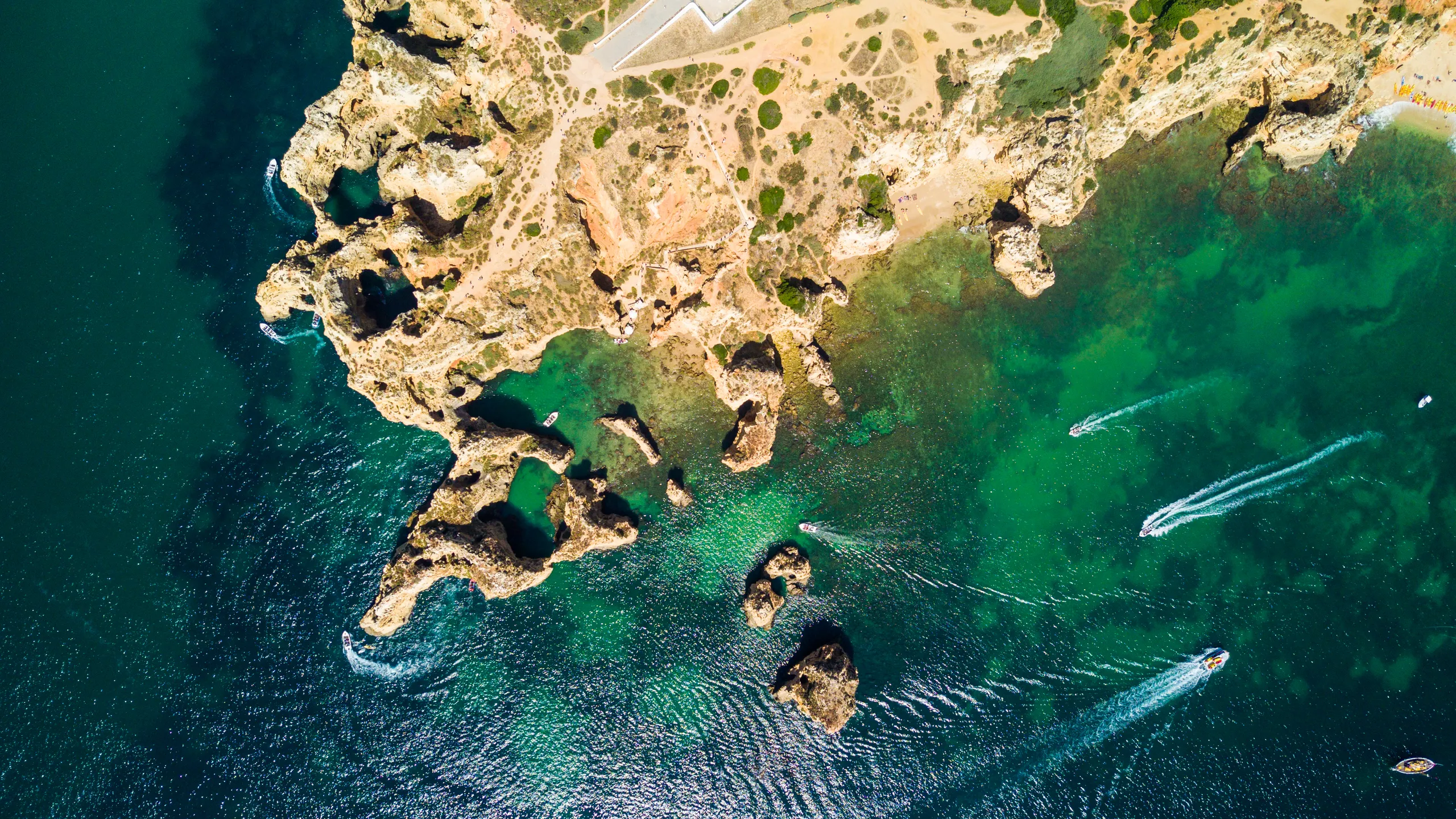
The Ponta da Piedade headland at Lagos is the clearest case in this comparison. The Portuguese geosite inventory ProGEO-PT says its cliffs expose a Miocene carbonate formation, and that horizontal layers, variation in the rock and a high density of fractures "conjugate to produce a remarkable set of karstic features typical of carbonate shores, among them, caves and stacks". On Biševo the island's own visitor centre gives a similar account and adds the part that matters here: the Blue Cave was probably formed by waves driven by strong southern winds hitting a softer layer of rock, and "these rocks are still under the influence of the strong winds and waves that carve them".
Read that twice. The wind that dug the cave is the wind that shuts it. A sea cave is a hole the sea made, and the sea keeps the right to use it.

The Blue Grotto: a door you lie down to pass
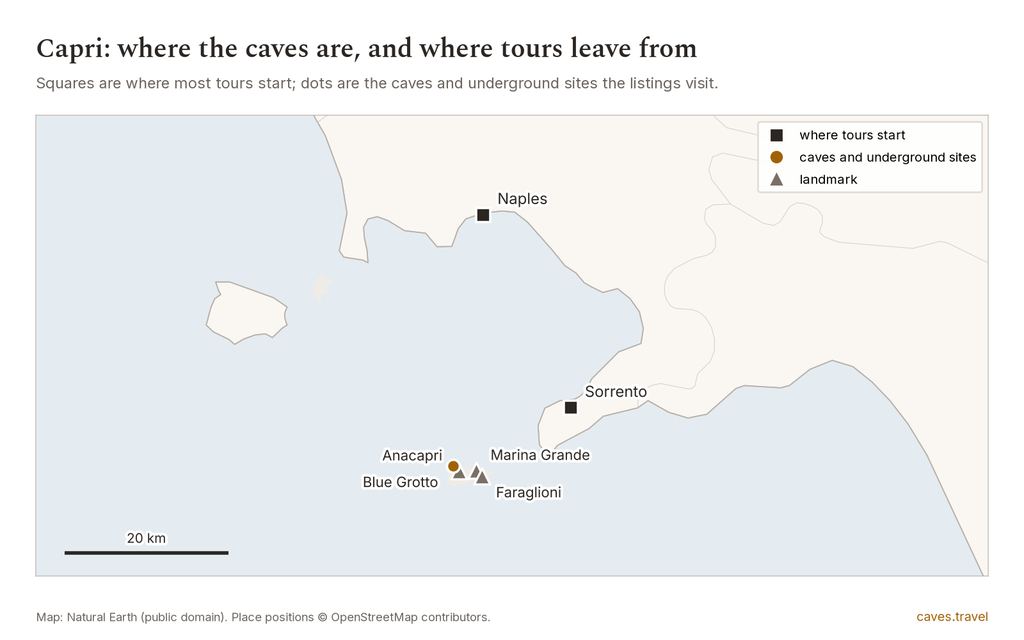
The Blue Grotto lies below Anacapri on Capri. The encyclopedia Treccani gives it a length of 54 m, a width of 30 m and a height of 15 m, reached by boat "from an opening 1.30 m high". The Comune di Anacapri, which runs the island's tourism pages, says one metre. The two figures do not agree, so "about a metre" is the honest version.
The grotto was known to islanders as Gradola. Treccani credits the German writer August Kopisch with giving it its fame in 1826. The Ministry of Culture, which looks after the site, says it is reached with small boats and that "in case of adverse sea and weather conditions the site will remain closed" (my translation). That sentence is the whole closure policy as published. There is no table of wave heights and no list of closed days.
Why is the Blue Grotto blue and the Biševo cave silver?
Seawater is a filter. The US ocean agency NOAA explains that the sea looks blue because water absorbs the red part of the light spectrum and leaves the blue behind. In a cave with a sunken doorway, all the light has to travel through that water before it reaches you.
Capri and Biševo explain the rest in slightly different words. The Ministry of Culture says the colour, which changes with the hour and the weather, comes from sunlight filtered through the opening and reflected off the sandy bottom of the cave. Treccani says the light is diffused in the water through an opening at depth. On Biševo, the visitor centre reports that a geological survey in 2019 found a light-yellow sandy floor in the entrance area and the main chamber. In the morning, with the sun in the east, light enters through the submerged entrance and bounces off that sand, which is paler than the rocks around it because they carry a growth of marine life. The same pages say the cave has two more openings besides the submerged one, one by sea and one by land, and that the 2019 survey counted 119 marine species inside, five of them strictly protected.
The silver comes from the first description. The painter Baron Eugen Ransonnet, who is credited with bringing the cave to the world in 1884, wrote of a "silvery-bluish" light and compared it to Capri. The tourist board still writes of a "blue-silverish glimmer".
The light is a reflection off sand, seen through a sunken doorway. Cloud, the angle of the sun and the clarity of the water change the colour, and no official source we read promises a month.
What the tourist board does say is that the best visit falls between 10 am and 2 pm, "depending on the time of the year". That is a window, not a guarantee. If you can choose, take late morning and treat the rest as luck.
| Cave | The door | How you get in | Where the light comes from | What the sea and the rules decide |
|---|---|---|---|---|
| Blue Grotto, Capri | About 1 m high (Anacapri); 1.30 m (Treccani) | Lying in a small rowing boat | Sunlight through a sunken opening, reflected off the sand (Ministry of Culture) | Closed in adverse sea and weather conditions (Ministry of Culture) |
| Modra špilja, Biševo | 1.5 m high, 2.4 m wide (Komiža tourist board) | Small boat; bathing, swimming and diving forbidden (code of conduct) | Submerged passage; morning sun on pale sand (visitor centre) | A door this low is easily blocked by swell (our inference); protected as a natural monument since 1951 |
| Benagil, Algarve | Two entrances to the main chamber: east for kayaks, west for motor boats (Edital 019/2024) | Boat or guided kayak; no landing, no swimming in | Daylight from an opening in the roof | 2 minutes inside for motorboats, 8 for a kayak group; closed in poor conditions or below 1,000 m visibility |
| Ponta da Piedade, Lagos | No single door: caves, arches and stacks in Miocene carbonate rock (ProGEO-PT) | By boat or kayak; we found no official access rules | Varies grotto by grotto | No official sea rule found for this headland |
| Koločep, Dubrovnik | No official measurement found | Swimming in, according to operator listings | Not documented by an official source | Nothing official to quote |
Two rows of that table carry a gap, and it is a real one. Koločep has no tourist-board page, no operator code and no published rules that we could find, so everything said about it comes from the tour listings summarized on the Dubrovnik page. Ponta da Piedade has a scientific description and no access notice. Where a cave has no official source we say so, because the alternative is repeating a blog.
How does the sea decide, and is it really the tide?
You will read that the Blue Grotto is accessible "only at low tide". We do not repeat it. The Ministry of Culture's own page says the cave can be visited by small boats "depending on the tidal cycle and the weather" (my translation), so the word is there. But the Mediterranean is a small-tide sea. A conference abstract by Italian marine researchers at CNR-ISMAR, presented at the European Geosciences Union in 2019, describes the Mediterranean as micro-tidal, with significant tidal oscillations "only in certain areas, namely, the North Adriatic Sea, the Gulf of Gabes, and the North Aegean Sea". Capri and the central Adriatic, where Biševo lies, are not on that list. The thing that moves the water against a one-metre door is swell, and swell is made by wind.
We found no published count of closed days for any of these caves. Figures like "closed 30 to 40 percent of days" circulate on blogs with no origin. What exists is a weather-station record. The Capri station, 160 m above the sea, reports in the World Meteorological Organization 1991-2020 climate normals how many days a month the wind reaches 10 metres per second or more. We averaged the months by season.
| Season | Days per month at 10 m/s or more | Note |
|---|---|---|
| December to February | 9.3 | Highest single months: December 10.6, November 10.0 |
| March to May | 6.4 | Falling from 7.7 in March to 5.1 in May |
| June to August | 2.7 | Lowest month: August, 2.1 |
| September to November | 7.5 | Rising from 5.7 in September to 10.0 in November |
The record runs to about 78 days a year at 10 m/s or more, and 9.1 days at 20 m/s or more, with the strongest winds in November and December. Winter is roughly three and a half times windier than summer by this count. Treat it as a shape and not as a forecast. The station is on a hill, wind speed is not wave height, and the entrance to the grotto faces its own direction. It says which season the sea is likely to be in a mood, which is as much as any source gives.
The Croatian weather service agrees on the Adriatic. Its climate pages for Croatia say that the strong winds, bura and jugo, "are more frequent and stronger in the cold part of the year", and that the jugo is more intense and frequent on the middle and southern Adriatic than on the northern part. Biševo, Hvar, Split and Dubrovnik all sit in that half. What this means on the day is covered on the page about what to do if your cave tour is canceled.
For the Atlantic coast of Portugal we make no tidal claim. We did not open a tidal source for Lagos or Benagil, and the notice that governs Benagil speaks only of "meteo-oceanographic conditions" and of any warning to mariners.
Benagil: what the harbour master's notice says, and how fast it changed

The Algar de Benagil is a chamber with a sandy floor and an opening in its roof, which is why photographs of it look nothing like the other four. The rules that govern it come from the Capitania do Porto de Portimão, the local office of the national maritime authority. Its Edital 019/2024, signed on 30 July 2024, took effect ten working days after publication. It covers the coast between the beaches of Vale do Lapa and Albandeira, which is inside the Parque Natural Marinho do Recife do Algarve.
The notice bans landing on or using the sand inside the Algar, reaching the cave by swimming or with a float, and entering the caves when visibility is under 1,000 m. Everyone aboard must wear a life jacket for the whole visit, and a helmet near the cliff sections where rock can fall. The introduction is blunt about why: the cliffs fail in "an intermittent and discontinuous sequence of instant collapses", the notice says, and it is "not possible to predict" them. Rockfalls with serious consequences have already been reported on this stretch. The fines, for operators, run as high as 216,000 euros for the gravest environmental offences.
Then the numbers. Under the original notice a motorized boat could stay 2 minutes in the chamber and a kayak group 8 minutes. On 2 July 2025, Edital 009/2025 amended the first one: more vessels may now be inside at once (up to five motorized boats and fourteen kayaks, where it had been three and seven), unguided kayak rental is not allowed, and the visit times stayed as they were. You can spend an hour on the water getting there and two minutes in the room.
A rule you read on a blog may be two notices old. The text on the maritime authority's site is the one that counts, and this one has already been amended once. Check it, or ask your operator which version it works under.
Dates that decide what you can do today
Only dates we read on an official or institutional page.
The origins
-
1826
Capri's grotto becomes famous
Treccani credits August Kopisch's descriptions of that year with the Blue Grotto's popularity; locals already knew it as Gradola.
-
1884
Biševo's cave is introduced to the world
The painter Baron Eugen Ransonnet visits the Blue Cave; the Komiža tourist board dates its public opening to the same year.
The growth
-
1951
Biševo's cave is protected
It becomes a geomorphological monument of nature, the status it keeps today.
-
2019
The Biševo geological survey
The survey explains the sand-reflected light and counts 119 marine species inside.
-
11 October 2023
Edital 324/2023 on Benagil
The harbour master's earlier notice, which the 2024 edital cites as the basis for warnings to mariners.
Today
-
30 July 2024
Edital 019/2024 published
New access rules for the Benagil caves take effect ten working days later.
-
2 July 2025
Edital 009/2025
The first amendment changes how many vessels may be inside the Algar at once.

Ponta da Piedade: no door, many rooms
Ponta da Piedade is the answer to a question the other four caves do not ask: what if the cave is a coastline? Boats and kayaks go along the headland's arches, stacks and grottoes, and each opening has its own size and its own light. ProGEO-PT, which keeps the national inventory of geological sites, rates the sector a paradigmatic example of the southern Algarve coast, and then adds a warning: it says human pressure is rising and that, "in a very short time", the sustainability of the sector "will be no more viable" without better coastal management.
For a visitor the consequences are plain. There is no single door to wait for, so the visit is less sensitive to one opening being blocked. There is also no equivalent of the Benagil notice that we could find for this headland, which is a statement about what we found and not about what exists. The Ponta da Piedade page compares the boats and the free cliff path.
Koločep: the cave where swimming is the way in
Tours from Dubrovnik do not go to Biševo, which is 176 km away. They go to a different Blue Cave, on Koločep in the Elaphiti islands, and the listings we read on the Dubrovnik page say you enter it by swimming. That makes it the opposite of Biševo, where the official code of conduct lists "bathing, swimming and diving" among the forbidden actions inside the Blue Cave, and of Benagil, where swimming in has been banned since August 2024.
It also makes Koločep the one cave of the five where we cannot give you a measurement, a rule or a regulator. Dubrovnik lies in the southern Adriatic, where the Croatian weather service says the jugo is stronger, so the sea sets the day here too. If you are a weak swimmer, the useful question is not whether the water is blue but whether the operator will tell you, before you pay, how long you swim and what happens when you cannot.
Which sea cave suits which visitor?
You want the textbook blue light. Choose the Blue Grotto or Biševo, accept a short visit and a sea that can say no. The two are different days: a rowing-boat door on Capri, a boat gap on a remote island. Read the Capri page or the Blue Cave page for the logistics.
You want a chamber with daylight from above. Benagil is the only one that fits, and it is also the one with the shortest time inside under the rules. The Benagil page reads the listings against the notice.
You want to see many caves from the water. Ponta da Piedade gives you a coast of them and no single make-or-break opening.
You want to swim in. Koločep. Biševo and Benagil forbid it, and the Blue Grotto is visited from a boat. The page on caves you visit by boat, swimming or tube goes further on that choice.
You do not like small spaces. The gaps are low, and some visits ask you to lie back in a boat. See cave tours for claustrophobic visitors, and for the wider decision how to choose a cave tour and the types of cave tours.
Questions about sea caves
Is the Blue Grotto only open at low tide?
We found no source that says so. The Ministry of Culture mentions the tidal cycle and the weather together, but the Mediterranean has small tides, and the closure sentence on the same page speaks of adverse sea and weather conditions. Swell and wind are the better explanation.
Can you swim in the Blue Grotto, Biševo or Benagil?
At Biševo the visitor centre's code of conduct forbids bathing, swimming and diving in the Blue Cave. At Benagil the harbour master's notice bans reaching the cave by swimming and landing on its sand. For the Blue Grotto, the pages we opened describe a visit by rowing boat and say nothing on swimming either way.
Which sea cave has the smallest door?
The Blue Grotto, at about a metre by the Comune di Anacapri and 1.30 m by Treccani. Biševo's is 1.5 m high and 2.4 m wide according to the Komiža tourist board.
Should I wear sunscreen if I swim in a sea cave?
The Biševo visitor centre asks visitors who swim in the island's sea caves to never use sunscreen there. The wording comes from its code of conduct, so it is a request tied to that place, but it is a sensible default for any cave with sheltered water.
What happens if the sea closes the cave on my day?
Closure is the rule and not the exception to it. The principles, and what you can reasonably ask the operator, are on the page about canceled cave tours.
If you book a tour from one of our category pages, the site earns a commission from the operator, at no extra cost to you. We do not rank operators on this page, and nothing above depends on the commission.
Compare the tours to these caves
Each cave has its own page with the listings that go there, read side by side.
Data verified on . Official pages and notices opened 19 Oct 2026. Benagil rules as amended 2 Jul 2025. Capri wind: WMO 1991-2020 normals. Koločep and Piedade access: no official source found.