
Two official cave pages, read on 19 October 2026, give opposite advice to the same fear. The Paris Catacombs say the visit is not recommended for people with claustrophobia, and list narrow passageways among the conditions. Kartchner Caverns, a state park in Arizona, publishes a whole page for anxious visitors: very wide tunnels, a ceiling about 15 feet high at the start, and never more than 1-2 minutes from an exit. Both are caves. Neither word, cave or tour, tells you how closed in you will feel.
So this page sorts tours by what triggers the fear: how low the ceiling gets, how narrow the passage is, how far the exit is, and if you can stop. It is a planning page, not treatment. If the fear is strong, the NHS guidance on claustrophobia says that avoiding confined spaces may reinforce it and that CBT and exposure therapy are available. A cave tour is a poor first step in that process. It is a good fifth or sixth one.
What makes a cave tour feel closed in?
We read the official pages of about a dozen caves and mines for this guide. Four things decide the experience. Ceiling height at the lowest point of the route. Width, which bothers many people more than height. Exit distance, meaning how long it takes to reach daylight if you stop. And anything that closes or moves without your say: an airlock door, a train, a boat. A tour can be dark and cold and still feel open if the hall is big and the exit is near. A tour can be brightly lit and feel tight if the corridor is shoulder-wide and one-way.
Three questions before you book: how low is the lowest point, how long do I stay in it, and what happens if I need to stop?
Which kinds of cave tour are tight, and which are open?
The table sorts the formats we cover by what their own operators or parks say. Where a source says nothing about passage size, the cell says so. That gap is information too: sites that are proud of wide halls usually mention them.
| Format | Tightest point | If you want out |
|---|---|---|
| Large show cave on a lit path (Kartchner, Postojna) | Airlock doors at Kartchner, a few seconds each | Staff walk you out; Kartchner says 1-2 minutes from an exit |
| Canyon cave with a split route (Škocjan) | The entrance tunnel, then a very large underground canyon | An early exit is built into the route: about 3 km instead of 5 km |
| Mine or catacomb circuit (Paris) | Narrow passageways and dim light, per the official site | One-way circuit; the exit is nearly 700 m from the entrance |
| Urban cistern tour (Naples) | A very short stretch lit by candles, which is optional | Back up the 136 steps; the other rooms are large and lit |
| Underground city (Derinkuyu) | Not stated: the ministry page gives depth, not passage height | Not stated |
| Tunnel network (Cu Chi) | Wartime tunnels as small as 80 x 80 cm, per a visitor guide site | Depends on the section you enter; ask |
| Sea cave by rowboat (Blue Grotto) | The entrance, about a metre high; you lie back in the boat | The boat leaves by the same mouth; inside time is a few minutes |
| Wild caving (Jewel Cave, USA) | A squeeze 8.5 in high by 24 in wide, set by the park | Not a short walk: the squeeze is the product |
Links to the destinations: Postojna, Paris, Naples, Cappadocia, Cu Chi and Capri. For the full sorting by cave type, see show caves, wild caves and other cave tours.

Underground cities: the passage nobody measured
The Turkish ministry of culture says Derinkuyu has an approximate depth of 85 metres, a ventilation shaft 55 metres deep, and that only ten percent of the city is open to visitors. It gives no height for the passages. The district government says the eight floors open to the public reach about 50 metres. Neither tells you how many times you duck.
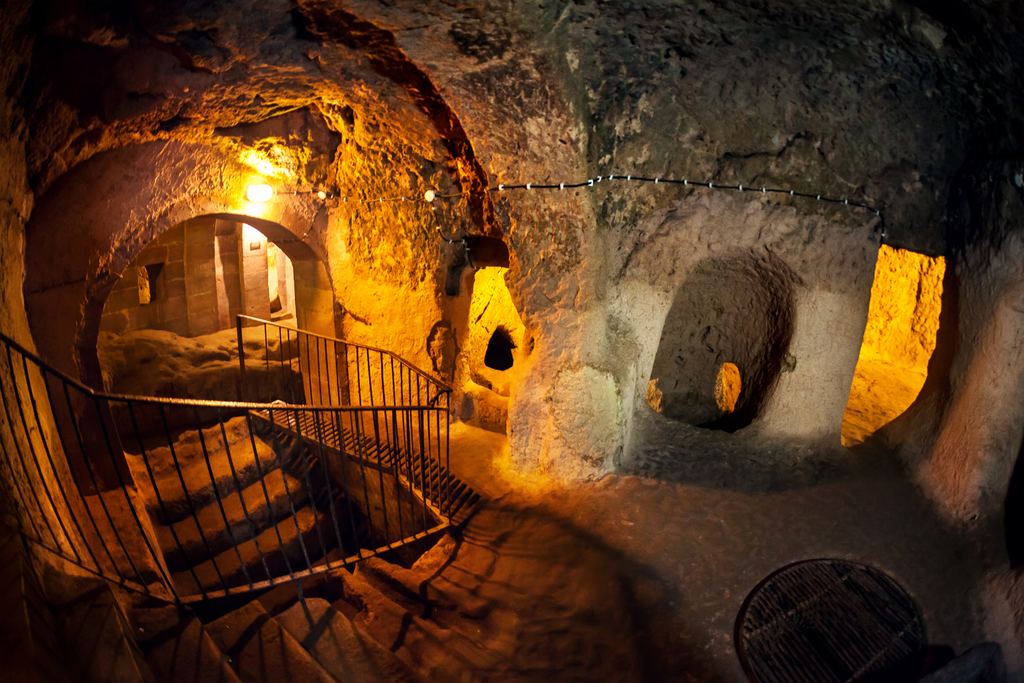
The stock photo beside this text shows a rolling stone door and a low arch. Treat it as a hint, not a measurement. If Derinkuyu is on your list, ask the guide or operator how long the lowest stretches are, and see our guide to underground cities, catacombs and mines.
Which tours say "not recommended" in writing?
Paris is the clearest. Its useful information page lists a risk of falling on an uneven and slippery floor, narrow passageways, dim light, and says the site is not recommended for people with claustrophobia, or with cardiac or respiratory insufficiency. The circuit is 1.5 km and one-way, entering at one avenue and leaving at another, and the visitor page puts the exit nearly 700 meters from the entrance. There is no door to step back through.
Wind Cave National Park in South Dakota says the same in its own words. Its tour safety page, last updated on 21 January 2026, calls every tour moderate to very strenuous, with stairs and occasional low ceilings, and says tours are not recommended for anyone with claustrophobia, heart or respiratory conditions, or recent surgeries. When an operator writes that sentence, believe it. It cost them something to write.
When is the squeeze the whole point?
Adventure tours are the uncomfortable case. At Jewel Cave in South Dakota, the park's FAQ tells you how to check the Wild Caving Tour before you reserve: stretch a string across a doorway 8.5 inches (about 22 cm) from the floor, about 24 inches (61 cm) wide, and have a friend watch you crawl under it. If you can pass without pulling it off, you fit. That test measures your body. It says nothing about how calm you stay in that space for the hours the tour lasts.
Fitting through a gap and being able to stay in it are different tests. Only the first one has a string.
The same applies to river caves with a swim or a crawl at the entrance. The Belize national institute's page for Actun Tunichil Muknal gives length (3.13 miles) and the date of Maya use, and nothing about passage size, so we can't tell you here how tight the ATM Cave gets. Compare the listings on our ATM Cave tours page against the words in the next section, and ask.
Which words in a listing give the tight parts away?
Listings can write around the word "tight". These are the words we would search for, in the tour description and the reviews.
- Warning words: crawl, squeeze, tight, narrow, hands and knees, helmet and headlamp, caving suit, wild, adventure, "fit and flexible".
- Reassuring words: walkway, handrail, train, lift, boat, wide galleries, large chamber, "suitable for beginners".
- Words that mean nothing: atmospheric, intimate, authentic, "off the beaten path". Intimate can mean a small group or a small tunnel.
Then ask four plain questions. How low is the lowest point? What is the longest stretch with no way out? Can I turn back at the first obstacle, or does the group move as one? How big is the group? Kartchner publishes its numbers: no more than 15 people on the Big Room tour and no more than 20 on the Rotunda/Throne Room tour, and the park says the trails are very wide. If an operator can't answer, that is the answer.
Why a one-way route changes the answer
On a loop or a one-way circuit you can't simply walk back to the entrance. The Paris circuit is the example we have an official source for. In a show cave with a staffed entrance, leaving early is a matter of telling the guide. In a one-way tunnel it may mean walking on.
The official Paris pages do not say what happens if you stop mid-route, so we can't say. Ask at the desk before you go down, when it costs nothing. The same question applies to the other underground tours in our guide.
Which tours let you leave halfway?
Kartchner says a trained staff person will escort you out if you need to leave for any medical reason. At Škocjan in Slovenia, the park's guided tour page describes a route of 2 hours 30 minutes to 3 hours, 5 km and about 1,000 steps, and offers an early exit after the Big Collapse Doline, which cuts the walk to 3 km and 500-800 steps. In January to April and October to December the tour ends at that exit anyway. The cave itself is a very large underground canyon, and the same page says the temperature is 12 °C. The Postojna Cave Park runs a train through part of its cave, and a train is the format where you most need to ask what happens if you want off.
At the other end sits the Blue Grotto. The Comune di Anacapri describes an entrance arch only about a metre high, entered lying down in a rowboat. Capri.com, a site run by local operators that also sells tickets, says the skipper pulls the boat through along a metal chain, that the cave mouth is about 2 metres wide, and that the visit inside lasts five minutes. Treccani gives the chamber as 54 m long, 30 m wide and 15 m high, with a mouth 1.30 m high. The sources differ on the mouth by 30 cm. The tight part is short and the room after it is big. If lying back under rock is the trigger, skip it. See our sea caves compared.

Doors, lights and the first minute
Kartchner's page is candid about the part you might not expect. To protect the cave, visitors pass through two airlock doors, and the park says the closed doors can trigger claustrophobia for some people. You are inside them for a few seconds each, and the airlock rooms are the smallest spaces on the tour. After the first door a large tunnel opens up.
In Naples, the official FAQ says the route goes down 136 steps to about 40 m, that the rooms are all large and lit except one very short stretch, and that the stretch is optional: you can use a phone torch instead of a candle. That's the shape to look for. The narrow bit is short, and you can decline it.
If the fear is mild and you want to try, choose the tour where the tightest point is brief or optional, and where staff stay with the group. Build up from a wide lit cave to one with a short narrow section. That is the logic the NHS gives for exposure therapy: gradual, a step at a time, on your own or with a professional.
Choose the tour where the tightest point is short, or optional, or both.
Our safety guide covers the other risks. Read how to choose a cave tour for the six decisions that matter more than fear, and Plan your cave trip for the full path.
Claustrophobia and cave tours: short answers
Can I leave a cave tour early?
It depends on the format. Kartchner says staff will escort you out, and Škocjan offers a built-in early exit. A one-way circuit such as Paris may not let you turn back. Ask before you book, and ask in writing if the answer matters.
Is the Blue Grotto claustrophobic?
The entrance is the tight part: an arch about a metre high, entered lying back in a rowboat, per the Comune di Anacapri. The chamber itself is large, 54 m by 30 m by 15 m per Treccani. Capri.com says the visit inside lasts about five minutes.
Are the Paris catacombs a bad idea for claustrophobia?
The official site says the visit is not recommended for people with claustrophobia, and describes narrow passageways, dim light and a one-way circuit. Take that at face value.
How do I know how tight a tour is before I book?
Search the description and reviews for warning words such as crawl, squeeze and narrow, and ask the operator for the height of the lowest point. A wide show cave will say so. A tight one may write around it.
Does exposure help?
The NHS says exposure therapy, a type of CBT that gradually exposes you to the situation, is one of the treatments for claustrophobia. It is gradual by design, so a cave tour is better as a later step than as the first.
If you book a tour through links on this site, Caves Travel earns a commission at no extra cost to you. We list tours by destination, not by comfort level, so run the questions above on any listing before you pay.
Data verified on . Official pages read 19 Oct 2026: Paris, Kartchner, Wind Cave, Jewel Cave, Napoli Sotterranea, Škocjan, Postojna, Anacapri, Belize NICH. Confirm each site before travel.
Start with a tour that has a short narrow part
Naples Underground: large lit rooms, one optional candlelit stretch, according to the operator's FAQ.