
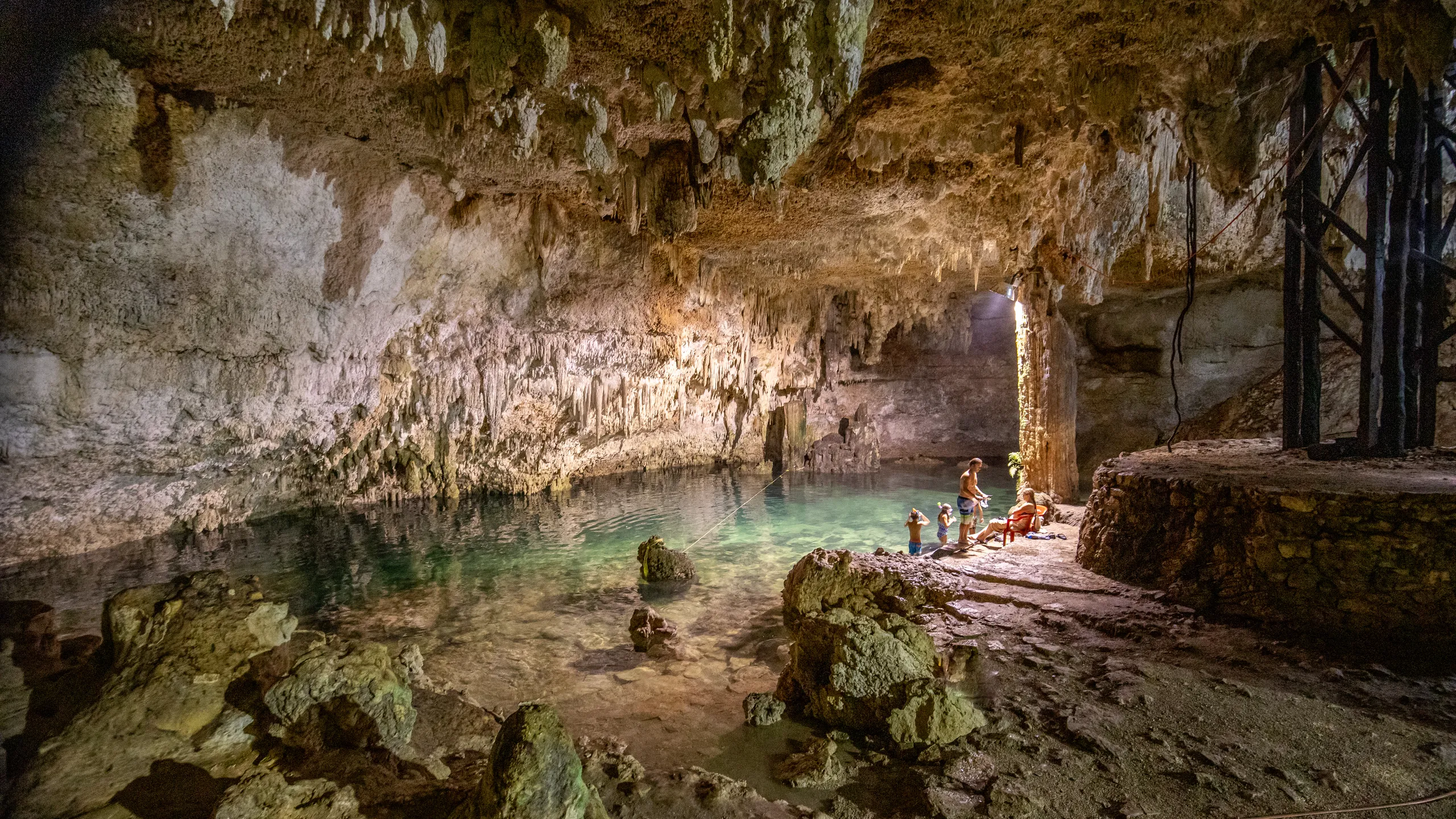
In a boat cave the water is the road. In a swimming cave it is the obstacle, and in a tube cave it is the vehicle. Those three roles ask for different skills, bring different risks, and react differently when it rains. A tour called "cave swim" can mean any of them, and in several places it now means none, because the cave itself has been closed to swimmers.
This page sorts the water caves of this site by the way the water carries you. The caves behind it are the rowboats of Trang An and Tam Cốc, the sinkholes around Tulum, the river caves of Cayo District in Belize and the sea caves of Croatia, Italy and Portugal. For the sea caves on their own, see sea caves compared.
How does water carry you into a cave?
| Mode | Where on this site | What you do | What the sources say |
|---|---|---|---|
| Sitting in a rowed boat | Trang An and Tam Cốc, Vietnam | Sit still while someone else steers | At the docks each sampan is guided by a boat person "who rows with their feet, not their hands", into "dripping grottoes" (Vietnam Tourism) |
| Lying in a small boat | Blue Grotto, Capri | Lie back under an arch about a metre high | The Comune di Anacapri describes lying down in a rowing boat under the entrance arch |
| Swimming in | Cenotes near Tulum; Koločep | Swim from daylight toward the dark | Cenotes form where limestone roofs collapse and expose the water table (PMC studies); Koločep has no official source |
| Floating on a tube | Nohoch Che'en, Belize | Drift with a river through the cave | "Visitors can have the experience of navigating through the cave on inner tubes" (National Institute of Culture and History, Belize) |
| Wading and scrambling | ATM cave, Belize | Cross water on foot and swim short stretches | 3.13 miles of cave, used by the Maya from AD 300-600 (National Institute of Culture and History) |
Look at the right-hand column and the pattern shows up. Boats are controlled by someone else. Swimming is controlled by you. Tubes and wading depend on a river, and a river is controlled by the weather upstream, often a day before the rain reaches your cave. The more control you hold, the more the cave asks you to be competent. If you are weighing a cave against your own limits, how to choose a cave tour sets out the questions in order.

Boat caves: you sit, but someone else has to be able to see
The boat caves of Ninh Bình are the gentlest way into a water cave. UNESCO, which inscribed Trang An in 2014, describes limestone peaks "permeated with valleys, many of them partly submerged", and says explorations of caves at different altitudes have found traces of human activity over more than 30,000 years. Vietnam Tourism adds what the visit feels like: you go "along gentle waterways, past towering karsts, and into dripping grottoes" in a sampan steered with the rower's feet. The category page for Trang An and Tam Cốc reads the day trips; this page only needs the principle.
The principle is that the water does the moving and you do nothing, which is also the problem. Nothing in a rowed boat prepares you for the case where the boat stops being an option. On the sea the same logic holds, with a much shorter list of weather it tolerates: the Blue Grotto uses small rowing boats and closes when the sea does, as the sea caves page explains.
At Benagil the authorities have decided what you wear in the boat. The harbour master of Portimão's Edital 019/2024 requires everyone, visitors and crew, to wear a life jacket throughout the visit, and a helmet when near the cliff sections where rock can fall. Boats and kayaks go in by separate entrances, and the visit is timed: 2 minutes for a motorized boat and 8 minutes for a kayak group, figures the amendment of 2 July 2025 left in place. A cave you cannot swim into is a cave you see from a seat, and the notice was written to make sure of that.
Swimming caves: where does the cave begin?
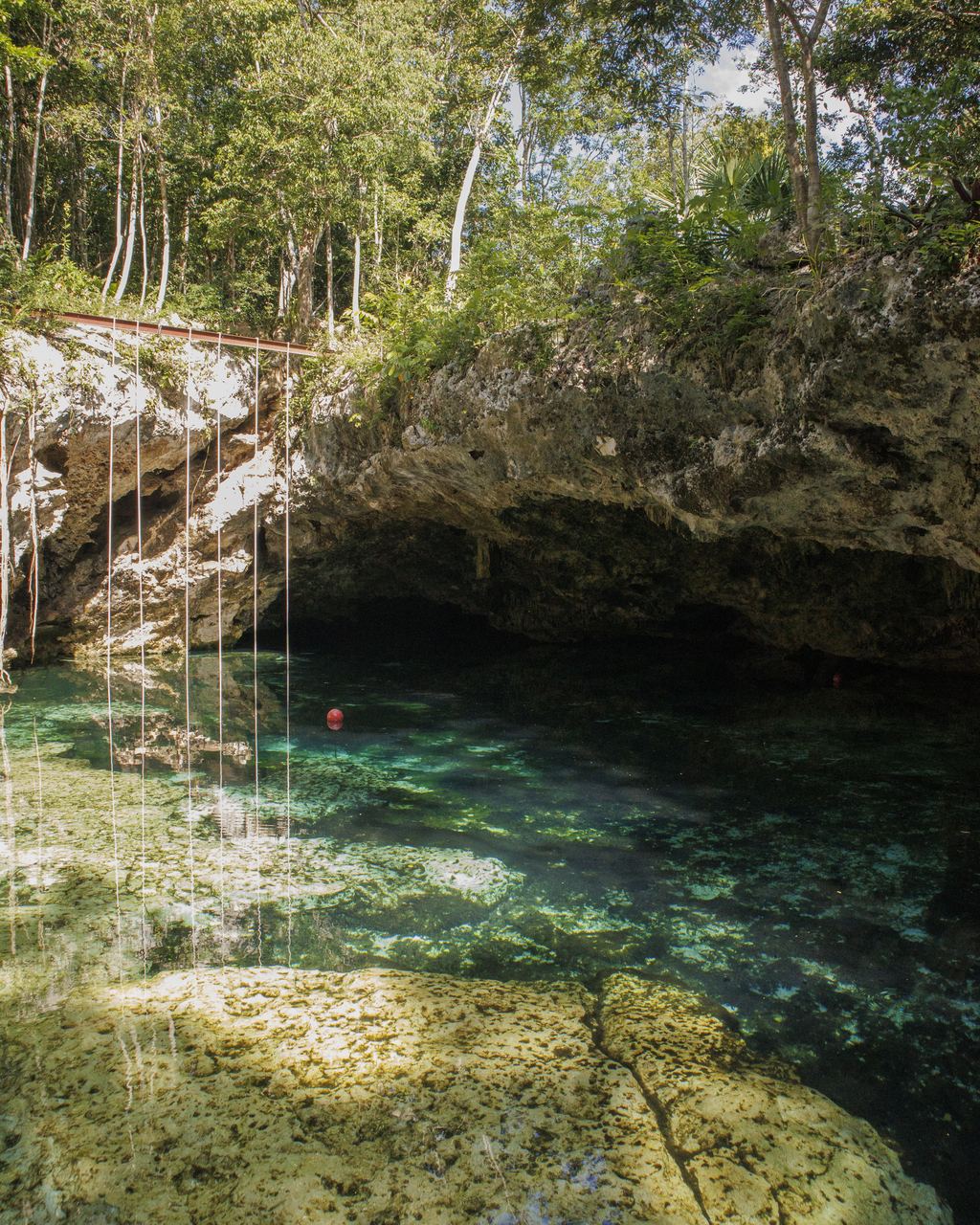
A cenote is a sinkhole, and the research is blunt about how it forms. An open-access study in Microbial Ecology describes the Yucatán Peninsula as karst terrain full of flooded sinkholes "formed by the collapse of limestone bedrock and known locally as cenotes" (Microbial Ecology, 2024). A second paper on the Caribbean side of the aquifer adds a detail swimmers feel without knowing it: the water is "density-stratified", with a lens of fresh water lying over saline groundwater. Fresh water floats on salt, and in a deep sinkhole the boundary can be seen.
The diving school PADI describes one such boundary at Cenote Angelita, where a layer of hydrogen sulfide "separates the incredibly clear fresh water from the salt water below at approximately 100 feet (30 meters)" (PADI blog). You will not meet that layer on a swimming tour. It is a good reminder that a cenote is a doorway to an aquifer, not a pool.
Which brings up the line that matters. A roofless cenote is a swim in a hole in the ground. Where the roof closes over the water, the sport changes name. PADI's cavern course teaches divers to stay "within the light zone for an easy exit to open water", and its safety note is flat: "Never undertake scuba diving in caves if you do not have the proper training." Snorkeling and swimming in the lit part of a cave cenote follow the same logic, even without a tank. Stay where you can see the daylight, and follow the guide's rope.
For what a cenote is and the types you meet, read cenotes explained. The tours themselves are on the Tulum cenote tours page.
If a listing says "cave" and "swim", ask two things before you pay: how far from daylight does the swim go, and who holds the rope.
Tube and wade caves: the river decides
The National Institute of Culture and History of Belize lists Nohoch Che'en (Caves Branch) as a popular site where visitors navigate the cave on inner tubes, and says the caves were carved out of the limestone foothills of the Maya Mountains by the river. That is the whole mechanism in one sentence. A river made the cave, and the same river is the route in, so the river's level is the first thing that decides a visit.
The National Meteorological Service of Belize says most of the year's rain falls from June to November, and that the rains reach the Cayo District in late May. It also records something that surprises people who plan around a single wet season: a break in August, known as the Mauga. The Central Farm station in Cayo shows it in numbers: about 194 mm of rain on average in July, 157 mm in August and 209 mm in October, which is the wettest month of the 1991-2020 record.
What that does to a given cave on a given morning we could not establish from an official source. Neither the Institute of Archaeology nor the tourism board publishes a river level at which a cave closes. We say so because the opposite claim, a tidy list of safe and unsafe months, would be invented. The page on caves in the rainy season collects what we do have, and the Belize cave tubing and ATM cave pages show how operators handle a closed cave.
What does rain change, mode by mode?
| Mode | What the water does | What an official source says |
|---|---|---|
| Sea caves by boat | Swell and wind raise water against a low door | Blue Grotto: closed in adverse sea and weather conditions (Ministry of Culture). Benagil: allowed only when sea conditions permit and visibility is at least 1,000 m (harbour master) |
| Karst river by boat | River level and flood | Phong Nha: dry weather is best, and the flood-prone months of September to December are best avoided (Vietnam Tourism). Ninh Bình: no official flood rule found |
| Tube and wade caves | River rises after rain | Belize: rains June to November, with a dip in August (National Meteorological Service). No official closing level found |
| Cenotes | Rain reaches the pool through the roof opening | No official statement found on rain and visibility |
Look at how the third column fills and empties. Where a government body owns the cave, as with the Blue Grotto and Benagil, there is a sentence to quote. Where a cave sits on private or shared land, the rule is the operator's, and the operator's cancellation terms are the document to read. The page on canceled cave tours lists what to ask before you book.

When does "swim" mean the cave and when does it mean the sea?
Here is the uncomfortable part. On many boat tours the swim stop is a dip in open water next to the cave, not inside it. The rules explain why. At Biševo, the island's visitor centre lists "bathing, swimming and diving (in the Blue Cave)" among the forbidden actions (code of conduct), and adds that if you swim in the island's sea caves you should never use sunscreen. At Benagil the harbour master has banned reaching the cave by swimming or with a float since August 2024. Old videos of people swimming into the Algar show something that is no longer allowed.
Koločep is the exception that proves how much rests on one place: operators describe a cave you enter by swimming, and we found no official page that confirms or forbids it. The Dubrovnik Blue Cave page says as much.
Cold is the other thing a listing rarely mentions. California State Parks, in a fact sheet on cold water, says a person has one minute to get through the cold shock response and about ten minutes of meaningful movement, and advises that you "dress for the water temperature, not the air temperature". The document is about boating in California, not caves, and the numbers are for frigid water. The principle travels, because the water you enter may not be at the temperature you dressed for. For clothing by cave type, see what to wear on a cave tour, and for the risks in order, are cave tours safe.
Questions about water caves
Do I need to swim to visit a water cave?
Not for a rowed boat or a sea cave you enter by motorboat, where a life jacket may even be required. For a swim-in cenote or a cave where you wade and swim short stretches, yes. Ask the operator how long you are in deep water, and whether non-swimmers are escorted.
Can I swim into the Blue Cave in Croatia?
Not at Biševo. The visitor centre's code of conduct forbids bathing, swimming and diving in the Blue Cave. Tours from Dubrovnik go to a different cave, on Koločep, where operators describe a swim.
What is the difference between a cenote and a cave?
A cenote is a flooded sinkhole formed where limestone collapsed onto the water table. Some are open to the sky and some are caves with a roof. The swimming part and the cave-diving part are different activities, and the dividing line used by dive training is whether daylight still reaches you.
Is the rainy season a bad time for a river cave?
It can be, and it can also be the time a cave looks its best. We found no official closing level for the Belize caves. The page on caves in the rainy season explains what is known.
Should I wear sunscreen in a cave pool?
Rules differ by site. Biševo's code asks swimmers in sea caves never to use it. We did not open a source that settles the question for every cenote, so read the instructions at the gate.
Tours that float or swim into caves
The listings behind the cave tubing page, read side by side.
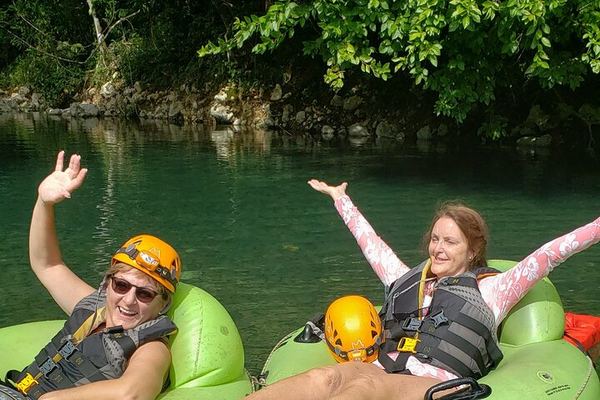
Belize City Cave Tubing With Chicken Tamale Lunch and Round-Trip Transfers
Round-trip transfers from Belize City hotels or the cruise port, a rainforest hike, a tube float and a chicken tamale lunch with water, all fees included.
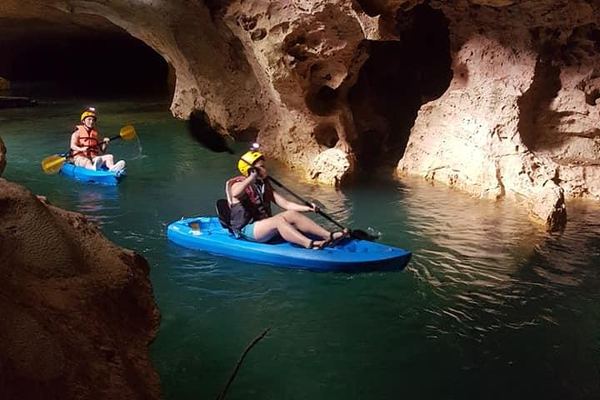
Cave River Kayaking With V.i.V., Pickup From Belize City Cruise Port
V.i.V. collects guests at the Belize City cruise port, hotels and water taxi terminal for single or tandem kayaks, helmets, life jackets and a forest walk.
Cave Tubing and Crystal Cave Tour From Belize City
A small-group day from Belize City with hotel or cruise port pickup, cave tubing, the Crystal Cave and a cenote swim. The entrance fee is included.
Ratings collected by Viator and Tripadvisor
If you book through the links on this site, we earn a commission from the operator at no extra cost to you. We do not rank operators here, and the sorting above would be the same without the commission.
Pick the cave, then the tour
The Tulum page reads cenote tours from swim-in pools to guided cavern days.
Data verified on . Official pages and studies opened 19 Oct 2026. Rain figures: Central Farm station, 1991-2020 normals. No official closing level found for Belize caves.