
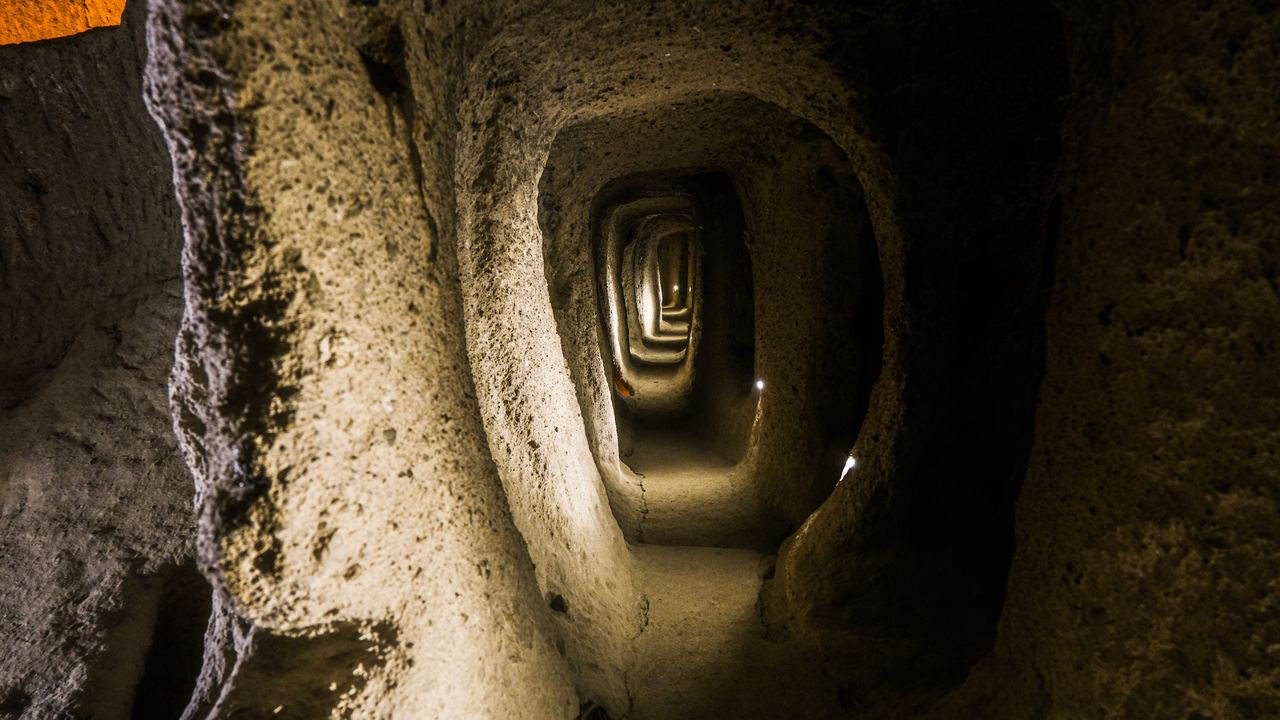
The Turkish culture ministry's page on Kaymaklı, an underground city in Cappadocia, says the passages were built low, narrow and long to restrict the enemy's movement. It tells you more about a visit than most guidebook adjectives: low means stooping, narrow means a queue. Every place on this page has an equivalent sentence. Nobody dug these spaces for visitors. They were dug to hide in, to bury people in, to take stone or salt out of, or to fight from, and the original purpose still sets the width of the corridor, the number of steps and how cold it is.
This page sorts six of them by purpose. It gives no prices and no ranking, and the choice of tour stays with the category pages for Cappadocia, Naples, Rome, Paris, Wieliczka and Cu Chi. Where two official sources disagree we print both numbers. We read every source on 19 October 2026.
What was each of these places dug for?
The table comes first, because the rock and the motive together explain most of what follows. Soft tuff runs through three of the six: Cappadocia, Naples and Rome. For the Cu Chi tunnels none of the sources we read names the soil, so the cell says so.
| Place | Rock | Dug for | Earliest date we can source | What you walk through |
|---|---|---|---|---|
| Derinkuyu and Kaymaklı, Turkey | Soft tuff | Refuge, storage, living space | Rock-cut homes in the region date back to the 4th century (UNESCO). No firm date for the cities in the sources read. | Stables, kitchens, a church; Kaymaklı has low, narrow, sloping passages |
| Naples Underground, Italy | Neapolitan yellow tuff | Building stone, then cisterns and shelters | Greek era. The operator says 3rd century BC on one page and 4th century BC on another. | Quarry rooms, an aqueduct system, wartime shelter; 136 steps down by the operator's FAQ |
| Rome catacombs, Italy | Tuff | Christian burial | End of the 2nd to start of the 3rd century AD (Pontifical Commission for Sacred Archaeology) | Galleries with burial niches; about 50 irregular steps at San Callisto |
| Paris Catacombs, France | Limestone | Quarrying, later an ossuary | Quarries from the 15th century; ossuary from the late 18th (City of Paris leaflet) | Bones stacked in walls; 131 steps down and 112 up |
| Wieliczka, Poland | Rock salt | Mining | Salt mined since the 13th century (UNESCO) | Chambers cut in salt, brine lakes, timber supports; about 800 steps |
| Cu Chi tunnels, Vietnam | Not named in the sources read | War | Built between 1946 and 1968 (Vietnamese state portal) | Tunnels; visitors can crawl through some of them |
Cappadocia: a city built to slow people down
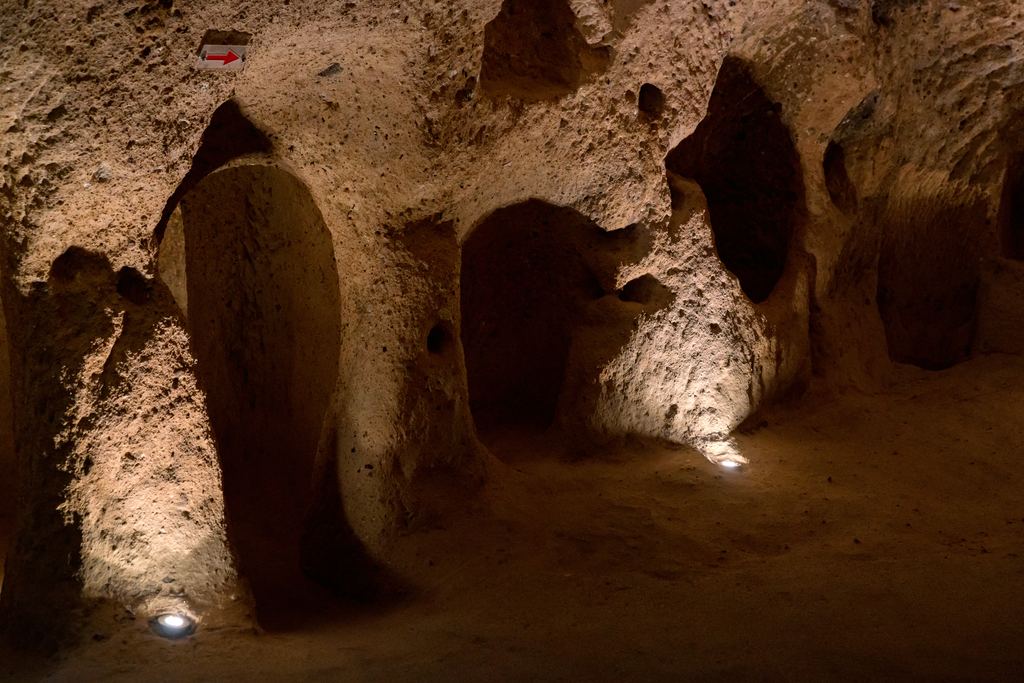
Cappadocia has an estimated 150 to 200 underground settlements, according to the culture ministry's page on Derinkuyu. Most were made by carving downward into soft tuff. The ministry gives two reasons: a secure refuge in case of attack, and a room that stays cool in summer and warm in winter. UNESCO's text for the Göreme site, in a copy archived in 2024, says hermit communities began living in rock-cut cells in the 4th century and that later, to resist Arab invasions, people banded together in subterranean towns such as Kaymaklı and Derinkuyu.
Kaymaklı is the one with the sentence quoted above. Its ministry page describes passages that are low, narrow and sloping, with four floors uncovered around ventilation shafts, and calls it the widest underground city explored so far. At Derinkuyu the entrance floors held stables, because animals could not be led lower, and kitchens and a grape-processing room were built above the deeper levels so that grapes and food could be moved in easily. A shaft 55 meters deep doubles as a well.
Depth is where the sources part ways. The ministry gives Derinkuyu an approximate depth of 85 meters. The district governor says the eight floors open to visitors reach 50 meters and that 85 is an estimate for a fully cleared city. The ministry adds that only about 10 percent can be visited, and the two pages differ on the opening year, 1965 against 1967. The smaller number is the one your legs will meet.
Naples: a city that grew on top of its own quarry
Naples is the place on this page where the stone and the buildings above it are the same material. A review of the city's geomaterials published by Virtual Explorer calls Neapolitan yellow tuff the most used building stone of the city and region since Greek times. It says the stone was mostly quarried underground, sometimes directly below the site of the building. That saved transport and left the surface free. The galleries were later reused for worship, rainwater reservoirs and cellars, and more recently as air-raid shelters. The authors conclude that growth above ground was strongly shaped by the digging below.
The operator of Napoli Sotterranea tells the same story from its side. Greeks cut the first underground quarries for the blocks of their walls and temples, Romans of the Augustan era added road tunnels and an aqueduct fed by springs at Serino, 70 km away, and the cavities became bomb shelters in the Second World War. Its route goes down 136 steps to about 40 meters, according to the site's FAQ, although another answer on the same page says 121. The rooms are large and lit. The only narrow stretch is a short tunnel lit by candles, and it is optional: people who would rather not go in wait outside.
One page on that site describes tuff as a sedimentary limestone built up from marine sediments and volcanic ash. Tuff is not limestone, and the review above groups the Naples stone with the volcaniclastic products of the Campi Flegrei, meaning rock made of consolidated volcanic fragments. We mention it because the origin is the point. The San Gennaro catacombs attribute their unusually large spaces to the workability and strength of the tuff: soft enough to quarry, strong enough to leave a roof standing. That helps explain why parts of the Naples underground are rooms and not just tunnels. The Naples category page covers the places you can visit.
Rome, Paris and Naples: three different things called catacombs
The word covers three separate kinds of place, and the same word is printed on all three.
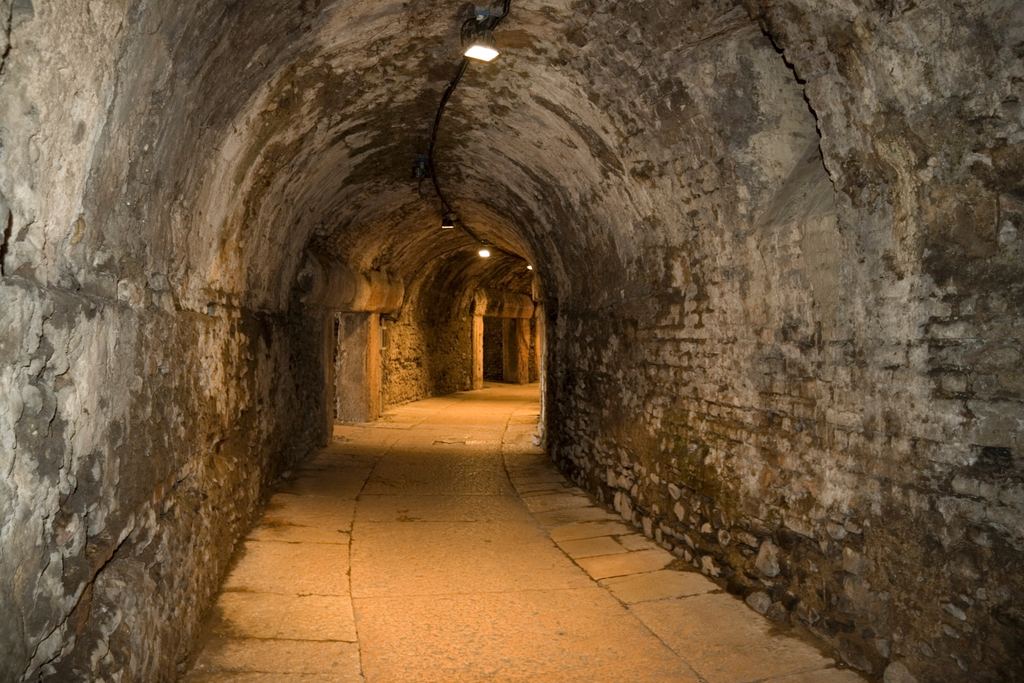
Rome is the original meaning, with a twist. The Pontifical Commission for Sacred Archaeology says the Christian catacombs began between the end of the 2nd and the start of the 3rd century, under Pope Zephyrin (199 to 217), who put the deacon Callixtus in charge of the cemetery on the Appian Way. They were dug mostly in tuff or similar easy-to-cut ground, with ladders leading down to galleries "as in mines", and the dead were laid in niches in the walls. The commission adds that in antiquity the word catacomb referred only to the complex of St. Sebastian on the Appian Way; the others were called coemeteria, from the Greek for dormitory. San Callisto, on its own site, describes a network of galleries about 12 miles long on four levels, more than 20 meters deep. Its visitor rules (in German) put the temperature at about 16 °C, mention 50 irregular steps at the entrance and exit, and forbid filming and photography.
Paris is the odd one out, because the bones came second. The city's own leaflet says the ossuary was created in the late 18th century inside abandoned quarries that date from the 15th, after the Saints-Innocents cemetery near Les Halles was closed in 1780 over public safety. The Quarry Department, set up by royal decree on 4 April 1777 to shore up the Parisian subsoil, chose the site. Bones from the central cemeteries kept arriving until 1860, and the decorative arrangement is the work of the Inspector General of the Quarries, Héricart de Thury, around 1810. During the Revolution the ossuary was temporarily used as a morgue for people killed in the fighting. The leaflet opens the path with the words "Stop, this is death's empire!" and speaks of the remains of "several millions of Parisians", a phrase we keep because the city gives no count. The official visit page lists 14 °C, 131 steps down and 112 up, and a one-way circuit of 1.5 km.
Naples has both kinds of place and keeps them apart. The quarry-and-cistern route described above is one; the catacombs of San Gennaro, which their site dates from a 2nd-century nucleus, are the other, on two levels that do not sit on top of each other. The site gives a temperature range of 15 to 22 °C and calls itself fully accessible. Directly below, it says the step-free entrance is closed for maintenance of the tuff ridge beside it. That note was on the page when we read it, and it is the sort of detail to check before planning around anyone's mobility.
Ask what the place was dug for before you ask how long the tour takes. A Roman catacomb is a cemetery, a Paris one is an ossuary in an old quarry, and the Naples underground route is quarry and cistern.

Wieliczka: the one dug for money
Wieliczka was an industrial site for most of its history. UNESCO says its rock salt has been mined since the 13th century and that Wieliczka and Bochnia were worked continuously until the late 20th century. The mine's own figures give the scale: 9 levels, 245 km of corridors, a maximum depth of 327 meters, and about 9 million cubic meters of voids left by more than 700 years of work. Visitors can see 2 percent.
The tourist route covers about 3.5 km and reaches 135 meters, with about 800 steps, 380 of them at the very start, according to the information page. The mine states 17 to 18 °C on that route and says it needs no exceptional fitness. The miners route is a separate ticket: 1.9 km, 101 meters, 14 to 16 °C. Photography is allowed, strollers are discouraged because of the stairs, and bags above 20 by 20 by 35 cm stay at the surface. The route passes chambers cut in salt, brine lakes and heavy timber supports.
Cu Chi: dug to fight from, then opened to visit
The tunnels lie about 70 km northwest of Ho Chi Minh City. A Vietnamese state portal says they have a total length of 250 km and were built between 1946 and 1968. It adds that the site was classified as a Special National Monument by the Prime Minister in 2015, that documents are being prepared for a UNESCO nomination, and that visitors can experience crawling through the tunnels.

Two cautions. The 250 km figure comes from one official source, and we found no surveyed length to compare it with. And guides report that the sections open to tourists have been widened, but we found no official statement of the original dimensions, so we give none. Treat any exact width you read as unconfirmed. If tight spaces worry you, the page on cave tours for claustrophobic visitors says what to ask before booking, and the Cu Chi category page covers the two sectors.
For tight spaces, ask for the length of the narrow stretch and whether it can be skipped. "Is it claustrophobic?" gets you an opinion, not a measurement.
When each place was dug and when it became a sight
Only dates we could read on official or primary pages. Where a source gives a century, the year is a marker for ordering.
The origins
-
3rd or 4th century BC
Greeks cut tuff quarries under Naples
Napoli Sotterranea dates the first quarries to the 3rd century BC on one page and the 4th on another.
-
Mid 2nd century AD
San Callisto begins
The catacomb's own site places its origins about the middle of the second century.
-
4th century AD
Rock-cut living in Cappadocia
UNESCO dates the region's rock-hewn habitat back to the 4th century. The underground cities followed, with no firm date in the sources read.
The growth
-
13th century
Salt mining at Wieliczka begins
UNESCO says the rock salt has been mined since the 13th century.
-
15th century
The Paris quarries that will hold the bones
The City of Paris leaflet dates the abandoned quarries from the 15th century.
-
4 April 1777
Paris creates the Quarry Department
A royal decree sets it up to protect and fortify the subsoil. It later chooses the ossuary site.
-
1780
The Saints-Innocents cemetery closes
The municipality closes it over public safety, and its bones are the first to move underground.
-
Around 1810
Héricart de Thury arranges the ossuary
The Inspector General of the Quarries gives the bones their decorative layout.
-
1946 to 1968
The Cu Chi tunnels are built
The period given by a Vietnamese state portal.
Today
-
1978
Wieliczka on the first UNESCO list
The mine says it was inscribed in 1978 on the first World Heritage List.
-
1985
Göreme and the Rock Sites of Cappadocia inscribed
The UNESCO date of inscription for the Cappadocian site.
-
2015
Cu Chi becomes a Special National Monument
The classification by Vietnam's Prime Minister, according to the state portal.
What the digging means for your body
Cold depends on rock and depth, and the sites give different numbers: about 16 °C at San Callisto, 14 °C in Paris, 17 to 18 °C on the Wieliczka tourist route, 15 to 22 °C at the San Gennaro catacombs. Napoli Sotterranea says it monitors the microclimate but we found no figure, and the ministry's Cappadocia pages give none either, only "cool in summer and warm in winter". The page on cave temperature explains why the numbers differ and why none of them is a constant.
Steps are the next filter. Paris counts 131 down and 112 up, San Callisto 50 irregular ones at the entrance and exit, Naples 136 each way, Wieliczka about 800 in all. San Callisto and Naples say there is no lift, and Paris and San Callisto say outright that they are not accessible to wheelchair users. Wieliczka offers an adapted route by reservation. The Cave Fit Guide lines up what each site says, and cave tours for limited mobility covers the principles.
The surprising pair is Rome and Naples, which sell the same word and ask different things of a visitor. San Callisto's rules say the visit is not recommended for people with claustrophobia, and they ban photography. The San Gennaro catacombs present themselves as fully accessible. Photo rules vary just as much from one site to the next, and photography in caves sorts them by type of rule. For a wider map of cave types, see types of cave tours and the where to go guide.
Underground sites: quick answers
Are the Paris catacombs and the Rome catacombs the same kind of place?
No. Rome's are Christian burial galleries dug from the end of the 2nd century, mostly in tuff. Paris's are an ossuary made in old limestone quarries after a cemetery closed in 1780. Naples has a 2nd-century catacomb and, separately, quarry and cistern tunnels. The sources are the Pontifical Commission for Sacred Archaeology, the City of Paris and the San Gennaro catacombs.
How deep is Derinkuyu?
The culture ministry gives an approximate depth of 85 meters. The district governor's page says the eight floors open to visitors reach 50 meters and that 85 is an estimate for a fully cleared city. The ministry says about a tenth of the city can be visited.
Is the Cu Chi tunnel network really 250 km long?
That is the figure on a Vietnamese state portal, which says the tunnels were built between 1946 and 1968. We found no surveyed length to check it against, so read it as an official claim and not a measurement.
Which of these places is coldest?
Among the declared figures, Paris at 14 °C. San Callisto says about 16, the Wieliczka tourist route 17 to 18, the San Gennaro catacombs 15 to 22. Naples Underground and the Cappadocia pages give no figure.
If you book a tour from one of our category pages, caves.travel earns a commission at no extra cost to you. It does not change what is written above, and the official ticket is sometimes the cheaper way in: official ticket or guided tour says when, and how to choose a cave tour walks through the other decisions.
Underground city tours in Cappadocia
Where the page began: the cities dug to slow an enemy down.
All-Inclusive Cappadocia Mix Tour With Underground City, Zelve, Lunch and Onyx
Museum tickets, lunch, workshops, parking and private transport are bundled into this full-day tour, from an underground city to a pottery workshop and an onyx talk.
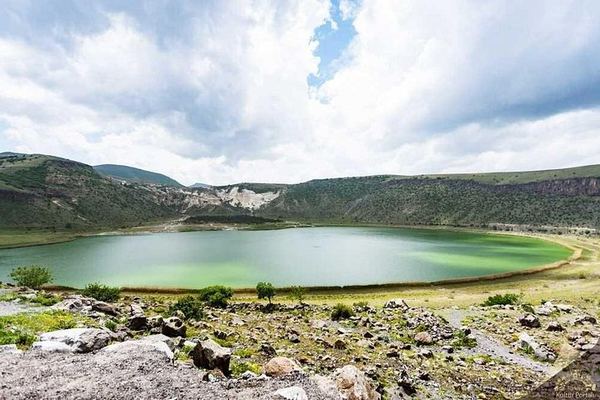
Derinkuyu, Ihlara Valley Hike and Yaprakhisar Panorama With Lunch and Tickets
Departure is from the Voyager agency office opposite Goreme Municipality. Entrance fees and lunch are covered, and the Ihlara walk follows the Melendiz River.
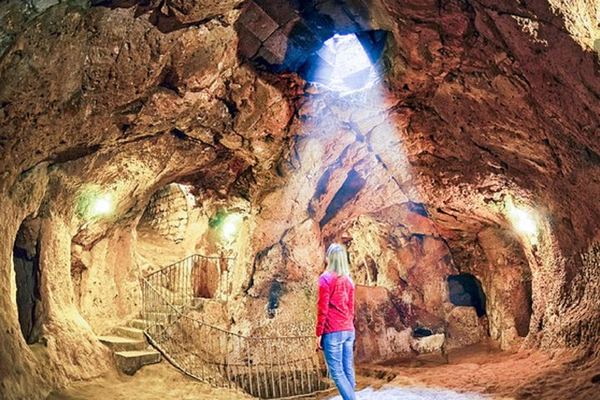
Full-Day Red Tour With Ozkonak, Avanos Pottery and Door-to-Door Pickup
Chauffeured hotel pickup and drop-off, a licensed guide and a pottery demonstration in Avanos fill this Red Tour. Lunch, drinks and gratuities are extra.
Ratings collected by Viator and Tripadvisor
Choose your underground
Tours for each place are listed on its category page. Start with the one whose original purpose matches what you want to see.
Data verified on . Read on each site's own pages on 19 October 2026. Where one site gives two numbers we print both.