
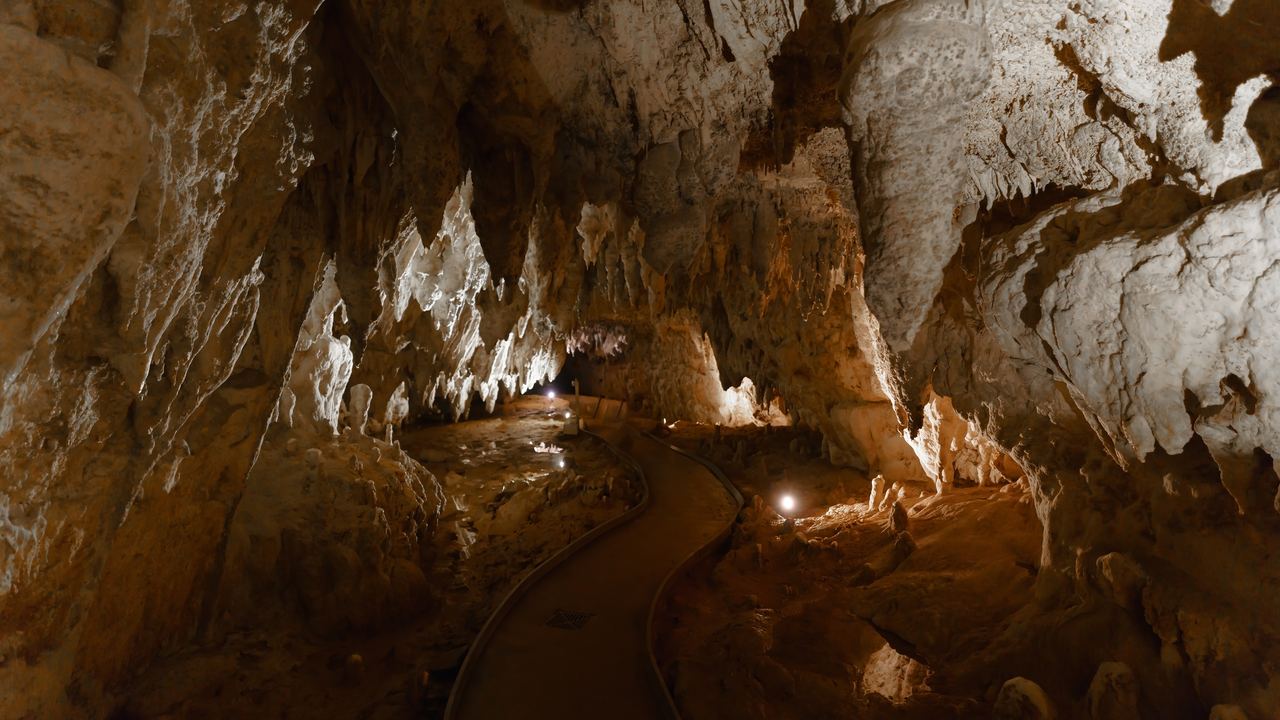
The glowworms of Waitomo are fly larvae, not worms and not fireflies. The olm in Postojna's vivarium is a salamander that a French breeding colony suggests can pass a century. And bats are the reason some caves close to visitors and others ask you to leave your clothes at the door. This page takes the three animals in turn, says what the sources agree on, and prints both numbers where they do not.
Everything below comes from park services, New Zealand's Department of Conservation and peer-reviewed papers, read on 19 October 2026. For the rock around the animals, start with how caves form; for what the air inside feels like, see cave temperature.
Are glowworms worms, fireflies or something else?
Something else. A 2015 open-access paper on the New Zealand glowworm, Arachnocampa luminosa, says it flatly: despite the common name, glowworms are a type of fly, order Diptera, family Keroplatidae. Fireflies, click beetles and railroad worms are beetles, a different order, and the two orders split about 330 million years ago. The paper calls the glowworm's light system evolutionarily distinct from the firefly's.
The chemistry agrees. A 2018 study in Scientific Reports found that the glowworm's light enzyme sits in the same protein family as firefly luciferase, but it works on an entirely new luciferin, the molecule that makes the light. Same kind of enzyme, different raw material.

How does a glowworm's light catch food?
The larva lies in a mucous hammock and lets long sticky silk threads hang below it, in the words of the 2015 paper, "like fishing lines". A small light organ at the tail end gives off blue-green light. Small flying insects head for it, tangle in the threads and are eaten.
The 2018 paper adds that the organ is derived from modified Malpighian tubules, a part of the insect excretory system. The Māori name, titiwai, means "projected over water".
In a cave the larvae glow at any time of day or night, according to Te Ara, the New Zealand government encyclopedia (we read an archived 2024 copy). Outdoors they start shortly after dark and usually shine all night. A cave has no daylight to compete with, so the display is there whenever your boat arrives.
The points of light on the ceiling are not decoration. Each one is a feeding larva, and the thread under it is the trap.
How big is a glowworm, and how long does it live?
The sources disagree on size, so here are both. Te Ara says a larva grows steadily for six to nine months until it is about 3 to 4 centimeters long. The Department of Conservation, on its Clifden Caves page, says glowworms grow up to 2.5 centimeters before they pupate. We do not pick one. Either way, a creature of two or three centimeters hanging in a hammock is not something you see as an animal from a boat. You see the light.
The rest of the cycle is short. Te Ara says the larvae hatch about three weeks after the eggs are laid, the pupa hangs from a thread for about two weeks, and the adult fly cannot feed and lives only a few days, long enough to mate and, for the female, to lay about 100 eggs. On which stages glow, the two sources part ways again: Te Ara says a fungus gnat can glow at every stage but the egg, DOC says only the larvae feed and produce light. They agree on one thing, that the larva is the bright one.
Where do glowworms live besides Waitomo?
The Scientific Reports paper describes A. luminosa as found in damp areas of forest, by streams and in caves throughout New Zealand. The genus occurs in Australia too: the same paper counts eight species endemic to Australia and a single species found only in New Zealand, and notes that glowworms are a major tourist attraction on both sides of the Tasman. DOC describes the habitat in the Clifden Caves as damp, with little or no wind.
That is the useful part for a visitor. The animal needs still, humid air, and a cave supplies it. If you are choosing between glowworm tours, the question is not which cave has the animal but how you will see it, on foot, by boat or both. Types of cave tours sorts out the formats, and the Waitomo glowworm cave tours page lists what runs from the site.

What is an olm, and why is it the star of Postojna?
The olm, Proteus anguinus, is a pale cave salamander found mainly in Slovenia and Croatia, says a 2011 paper in Biology Letters. Postojna Cave's own vivarium page gives its length as 25 to 30 centimeters and calls it the only vertebrate in Europe strictly bound to cave habitats. It feeds on crustaceans, snails and other aquatic invertebrates. The Škocjan Caves park lists the same world-famous cave salamander next to endemic underground crustaceans and beetles.
Postojna shows its olms in a vivarium that the park lists as an attraction of its own. When you read a listing for Postojna, check whether the vivarium is included or sold separately, and check the official site before you go.

The vivarium page also holds an older story. In September 1831, thirteen years after the great discovery of the most beautiful parts of Postojna Cave, Luka Čeč found a small brown beetle on a stalactite below the Great Mountain. It was named the slenderneck beetle, Leptodirus hochenwartii, and the page says its discovery refuted the belief that caves hold no life. That is the operator's account; we did not find a second source for the date. The park also says the cave is home to over 150 animal species, a count we would treat as a marketing figure that can change.
How long does an olm live?
Longer than almost anything its size. The Biology Letters team worked from a captive colony: in 1952 a cave at Moulis in France was fitted with riverbed-like basins, and a breeding program began at the end of the 1950s. From those records they predicted a maximum lifespan above 100 years, an adult average of 68.5 years, sexual maturity at 15.6 years and, on average, 35 eggs every 12.5 years. The animals weigh 15 to 20 grams.
Postojna's vivarium page says up to one hundred years and that an olm can go without food for several years. Another page of the same operator says up to 10 years without food. We write "years" and leave the number out.
The 100-year figure is a prediction built from a laboratory colony, not a measurement of wild olms. Treat it as the order of magnitude, not as an age you will ever see written on a tank.
Why do some caves close, and others ask you to change clothes?
Bats, and a fungus. The National Park Service's white-nose syndrome FAQ says the disease affects hibernating, insect-eating bats, that it has killed millions of bats in the US and Canada, up to 99% of some populations, and that it was first found in New York in the winter of 2006-2007. The fungus is Pseudogymnoascus destructans. The NPS says there is evidence it came from Europe, where bats do not suffer the same mortality.
It spreads from bat to bat by touch and from cave surfaces to bats, and the NPS adds that scientists think humans have the potential to carry the fungus from cave to cave. The national response protocol, in its March 2024 edition, says visitors to contaminated places may carry it on clothing or gear and that the spores can survive for months or years. This is the uncomfortable part for anyone who sells cave tours: the visitor is a possible vector, and in some places the response has been to restrict visitors.
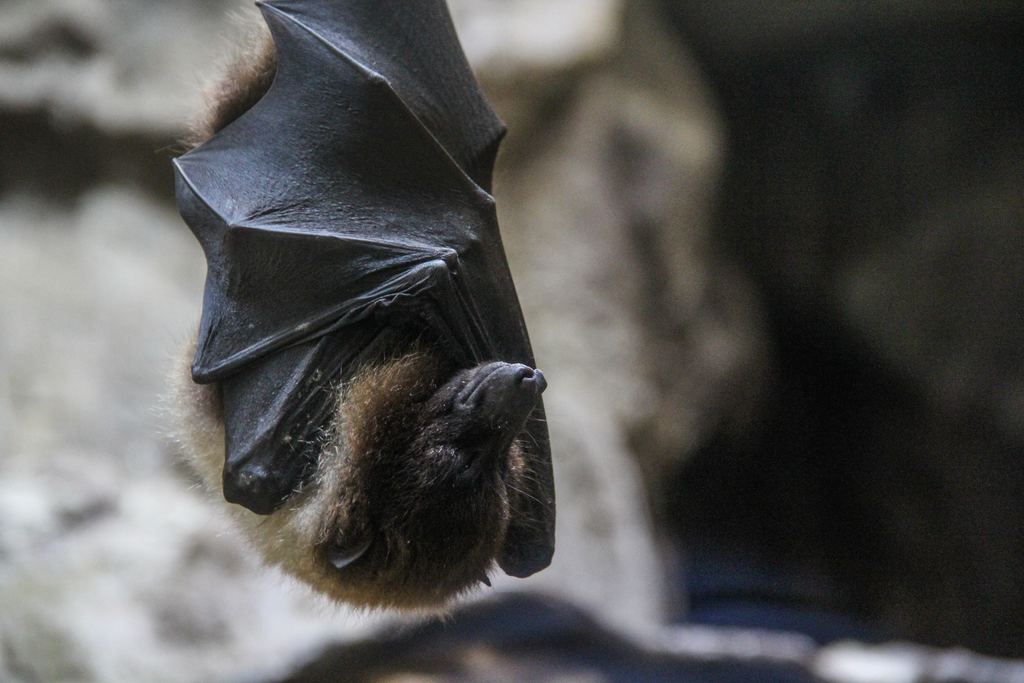
What that means on the ground depends on the park. The NPS says management has closed certain caves to protect hibernating and maternity roosts, that some parks offer to decontaminate shoes while others require you to leave clothing that has been underground, and that visitors may have to cross decontamination mats on the way out. Washing clothes does not kill the fungus, and the NPS best practice is to wear completely different clothes for each cave. These are North American rules. In Europe, where the NPS says bats do not suffer the same mortality, local practice may differ. It is worth asking at the desk.
The NPS also notes that about half the bat species in North America hibernate; those that migrate or live in warmer areas are not affected. More than 50 species live in national park land, in trees, old buildings, caves, mines and rocky features. A cave is one of several homes for a bat, not the only one.
Do bats in caves carry rabies?
The answer depends on contact, not on the cave. The World Health Organization's rabies fact sheet says that in the Americas, where dog-mediated rabies is mostly controlled, blood-feeding bats are now the primary source of human rabies. In the same section it says human deaths after exposure to bats, foxes, raccoons, skunks and other wild mammals are very rare. Its exposure table lists direct contact with bats as a category III, severe exposure, treated with wound washing, immediate vaccination and immunoglobulin.
The NPS makes the same split. No human infection from the white-nose fungus has been documented, but a small percentage of bats can carry other diseases such as rabies, and a bat acting oddly, for instance flying erratically, raises the chance of contact. Its advice for a dead or sick bat: do not touch it, tell a ranger. Nothing in these sources says a guided tour puts you in contact with a bat. They say what to do if you are.
If a bat is on the ground or flying badly, step back and tell the guide. Do not pick it up. If you are bitten or scratched, wash the wound and seek medical advice immediately.
What each animal asks of you
| Animal | What it is | Where tours show it | What it asks of you |
|---|---|---|---|
| Glowworm | Larva of a fungus gnat (a fly), with a blue-green light organ | Waitomo and other New Zealand sites; also Australia | Darkness and still, damp air; follow the guide on light and noise |
| Olm | Cave salamander, 25 to 30 cm, mainly Slovenia and Croatia | Postojna vivarium; listed by Škocjan park | Look, do not touch; check whether the vivarium is open |
| Bat | More than 50 species in US national parks alone, in caves and elsewhere | Caves, mines, trees and old buildings; a given tour may show none | Never handle one; follow local decontamination rules |
Rules on flash and tripods near animals differ from site to site; our photography page sorts them by type of rule. For the general risk picture see are cave tours safe, and for what is built into a tour before you book, how to choose a cave tour.
Quick answers
Are glowworms fireflies?
No. Glowworms in New Zealand are fly larvae (order Diptera). Fireflies are beetles (order Coleoptera). The two orders diverged about 330 million years ago, according to a 2015 paper on Arachnocampa luminosa.
Do all bats hibernate?
No. The National Park Service says about half of North American bat species hibernate. Species that migrate or live in warmer areas do not, so white-nose syndrome does not affect them.
What should I do if I find a sick or dead bat?
Do not touch it. The National Park Service tells visitors to report it to a ranger. On a tour, tell the guide.
How long does an adult glowworm fly live?
Only a few days, according to Te Ara. The adult cannot feed; it lives long enough to mate, and the female lays about 100 eggs.
A note on how this site earns its keep: if you book a tour through one of our links, we may earn a commission at no extra cost to you. It does not change what the sources above say. To go further into the underground, read cave facts and history and the cave glossary.
Data verified on . Sources: NPS, WHO, White-Nose Syndrome Response Team, DOC, Te Ara (archived 2024), Postojna and Škocjan parks, three open-access papers.
See the glowworm caves
Browse the Waitomo tours listed on this site.