
You will often read that caves stay at a constant 14 degrees. That is the number the Paris Catacombs print on their own visitor page, and the National Cave and Karst Research Institute says plainly that caves do not have constant temperatures. What they have is a stored average. Past the entrance zone, the air in many caves settles near the mean annual temperature of the place above, and that is why a cave can feel cold in August and mild in January.
This page explains the rule, shows it against seven real caves and catacombs with an original chart, lists the places where it breaks, and says what it should change in what you pack. All temperatures below come from official cave sites, national park pages and national weather services, read on 19 October 2026. When a site publishes no figure, we say that instead of borrowing one from a blog.
Why does a cave feel cool in summer and mild in winter?
The National Park Service explains it for Carlsbad Caverns. Once you are past the entrance area of most caves, temperature and humidity become fairly stable with little variation, because the outside weather barely reaches them. The temperature in these caves tends to reflect the average annual temperature for the area at that elevation, and relative humidity is usually close to 100 percent. A 2023 study in Scientific Reports by Medina and colleagues reached the same result by measurement: thermal averages inside caves approximately correspond to the annual average of surface temperature, and caves had a lower thermal amplitude than the surface.
The words "cool in summer, warm in winter" describe the weather, not the cave. The cave does not warm up or cool down. It holds one number while the surface swings around it. Postojna in Slovenia has monthly average highs of 26.0 C in July and average lows of minus 2.8 C in January (1991-2020 normals calculated from the national weather service series). A cave at 10 C is 16 degrees below the July high and 13 degrees above the January low. Krakow's average January high is 1.6 C. Wieliczka states 16 to 18 C inside.
The practical rule: dress for the cave's own number, not the weather on the road, and plan for standing still. A cave at 10 C feels colder during a slow walk with long stops than a 10 C morning feels when you are moving.
Do the numbers on official cave sites match the outside average?
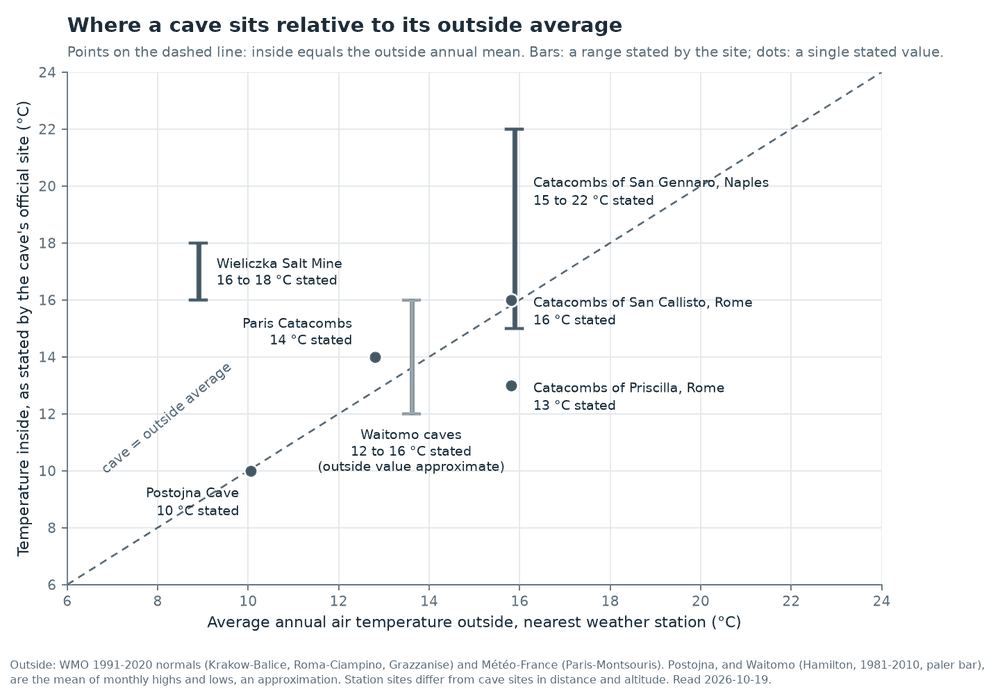
We put the question to the data. For each cave or catacomb whose official site states a temperature, we found the nearest weather station with a published 1991-2020 annual mean. The chart plots the stated inside value against the outside mean. A point on the dashed line means inside equals outside.
| Place | Stated inside | Outside annual mean and station | Gap |
|---|---|---|---|
| Postojna Cave, Slovenia | 10 C | about 10.1 C (Postojna station, 533 m) | about 0 |
| Catacombs of Paris | 14 C | 12.8 C (Paris-Montsouris) | +1.2 |
| Catacombs of San Callisto, Rome | about 16 C | 15.8 C (Roma-Ciampino) | +0.2 |
| Catacombs of Priscilla, Rome | approximately 13 (unit not printed) | 15.8 C (Roma-Ciampino) | -2.8 |
| Catacombs of San Gennaro, Naples | 15 to 22 C | 15.9 C (Grazzanise) | inside the range |
| Waitomo caves, New Zealand | 12 to 16 C, three different figures | about 13.6 C (Hamilton, 1981-2010) | inside the range |
| Wieliczka Salt Mine, Tourist Route | 16 to 18 C | 8.9 C (Krakow-Balice) | +7 to +9 |
| Skocjan Caves, Slovenia | 12 C dry areas, 0 to 20 C where water flows | no station read | not computed |
Sources for the stated values: Postojna, Paris, San Callisto, Priscilla, San Gennaro, Wieliczka and Škocjan. Outside means come from WMO climate normals for 1991-2020 (NOAA archive) for Krakow-Balice, Roma-Ciampino and Grazzanise, and from the Météo-France climate sheet for Paris-Montsouris. Postojna and Waitomo have no published annual mean in our files, so we used the average of the monthly highs and lows. That is an approximation, and the Waitomo figure comes from Hamilton, 60 km away, for 1981-2010.
The pattern is clear in the middle of the chart. Postojna, the San Callisto catacomb and the Paris Catacombs sit within about 1 degree of their outside means. Even so, three Roman catacombs give three kinds of answer. San Callisto states about 16 C in its German-language rules. Priscilla gives "approximately 13" without a unit. The Domitilla catacombs, in the brochure and site we read, give no number at all.
Waitomo is the cleanest example of a number that is not one. The operator's FAQ says 16 C year round, its top tips page says a balmy 12 to 14 degrees, and its Ruakuri Cave page says around 15 C and damp. They are one operator and three figures, so the page uses the range, 12 to 16 C.

Why does Wieliczka stand 8 degrees above its outside mean?
It sits far from the dashed line. The mine states 16 to 18 C on its Tourist Route and, in its 2025 visitor rules, an average of 17 C there and 15 C on the Mining Route. Krakow-Balice, 15 km away, averages 8.9 C. The mine does not explain the gap, so we do not claim a cause. We can say what physics allows.
The NPS notes that larger cave systems tend to capture heat rising from the Earth. The USGS reports that temperature gradients measured in mines and drill holes around the world range from 0.46 to 2.29 C per 100 feet of depth. The mine says the Tourist Route reaches 135 m. That is about 443 feet, and the arithmetic gives 2 to 10 degrees of added warmth at that depth. It is our calculation, not the mine's statement, and the weather station sits 15 km away and at a different altitude.
When does a cave break the rule?
Caves that pump air. The NPS calls the main portion of Carlsbad Caverns a cold trap. In winter, once the outside air drops below the cave air, cold and usually dry air plunges into the lower part of the entrance. The Big Room averages 13 C, cooler than the ends of the cave, while the deepest point stays at a steadier, warmer 20 C. The NPS page gives a second figure for that difference that does not match its own Fahrenheit numbers, so we repeat only the two temperatures.
Caves that run warm. At Lehman Caves in Nevada, the mean outside air temperature from July 2015 to July 2016 was 9.2 C. The NPS measured the cave air at 1.9 C higher, about 20 percent warmer than outside. The NPS suggests two possible causes: heat flowing up from the Earth, and the heat of visitors and lighting. The rule describes a tendency, not a law.
Entrances and airflow. The NCKRI states that the farther you go into a cave, the smaller the changes, and that caves with greater airflow have greater temperature variations. The first minutes of a tour, near the door, are not the temperature the website quotes. Water breaks the rule too: Škocjan states 12 C in dry areas and 0 to 20 C where water flows, with 80 to 100 percent humidity. Its home page also shows a live reading, which is a measurement and not a promise, so we do not quote it.
Why do ice caves not follow the rule?
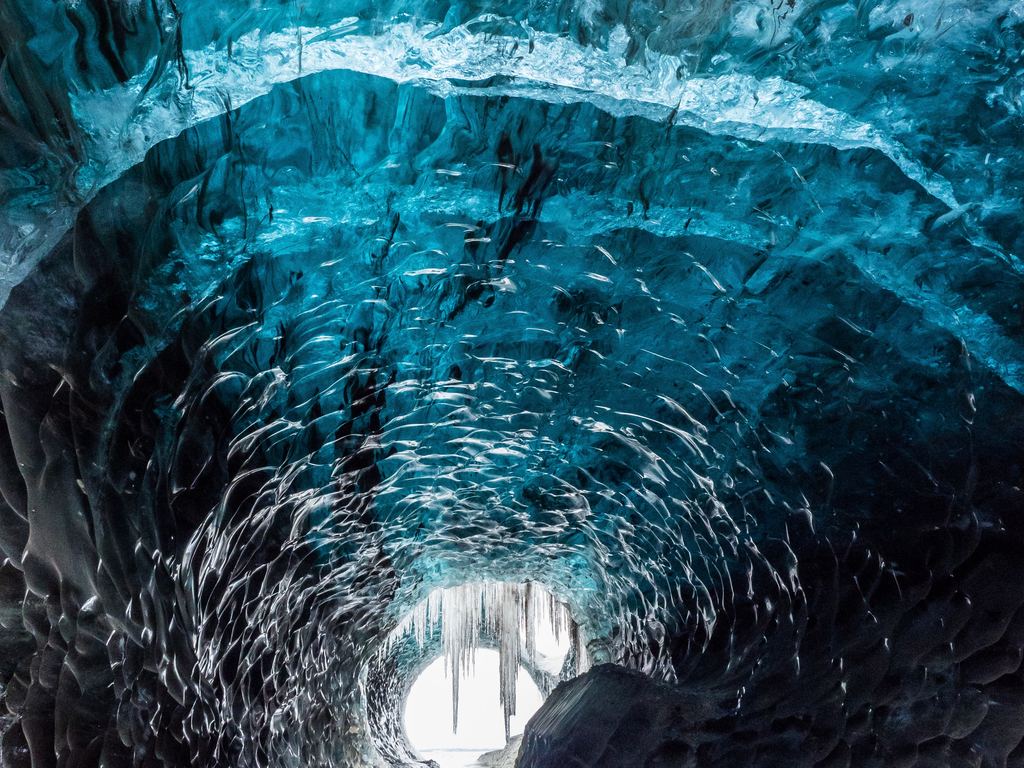
Ice caves are a different case because the cave itself is the temperature record. The NPS separates two types. A cave in rock that holds ice all year is an ice cave, and a cave formed in glacier ice by meltwater is a glacier ice cave. At Vatnajökull in Iceland the national park says geothermal hot water shapes ice caves on the glacier margin, and that meltwater can collect in small lagoons that empty suddenly. The park gives no temperature figures, only warnings about those hazards. We discuss the seasons in ice caves: when they exist and why.
And some sites do not publish any number. The Naples Underground site says it monitors temperature and the wider microclimate against outside conditions. It publishes no value, only advice to wear flat shoes and a sweatshirt in warm periods. For the Cu Chi tunnels, Derinkuyu, Phong Nha, ATM Cave and the Yucatán cenotes, the official pages we read give no temperature, and an open-access paper on cenote microbes says only "stable water temperature". Blog figures such as 25 C for a cenote have no primary source, so we do not repeat them.
Is constant the right word for a cave?
Cave sites use it freely, and the usage is looser than it sounds. Postojna calls its temperature "constant" at 10 C. The Paris Catacombs print "constant temperature: 14 C" on one page and "the average temperature is 14 C" on another, which are not the same claim. Wieliczka gives a range of 16 to 18 C in one place and an average of 17 C in its visitor rules, and a separate Mining Route at 14 to 16 C. The San Gennaro catacombs state 15 to 22 C, a seven-degree span that no one would call constant. Škocjan gives two ranges, one for dry areas and one for wet.
Read in the generous way, these are not contradictions. A measurement taken at a fixed point deep in a cave can show little variation through the year, as the NPS says, while a route that crosses wet galleries, entrance halls and deeper chambers will meet more than one number. The honest summary is that a cave tends to be stable at one point, and a tour is a line through many points.
Humidity is the second number that matters, and the sites give it less often. The NPS says relative humidity in most caves is usually close to 100 percent. Škocjan states 80 to 100 percent. Wieliczka's rules say up to 75 percent, and Paris says only that it can be very humid. A thermometer reading does not say how a place feels on your skin, so look for both numbers before you decide what to wear.
What should you do with these numbers?
Use the stated figure as a ceiling for comfort, not a guarantee. Dress for the cave at 10 to 14 C if you are visiting Postojna or Paris, and the official sites say so: Postojna recommends warm clothing and sports footwear, and Paris tells visitors to wear comfortable shoes and, because the wait outside can be long even in winter, to dress warmly. San Gennaro in Naples suggests a sweater even in warm periods. Our page on what to wear on a cave tour turns this into a checklist by cave type.
Water changes the arithmetic. A wet cave at 12 C can feel colder than a dry one at 10, because wet clothes lose heat faster. If you are going on a river cave, tubing or a swim, see caves you visit by boat, swimming or tube and the safety page on whether cave tours are safe. For cave words used here, such as cold trap and speleothem, the cave glossary has definitions, and the guide to how caves form covers the rock around the air.
Cave temperature questions
Are caves always 14 degrees?
No. The NCKRI says caves do not have constant temperatures. Paris states 14 C for its catacombs, Postojna 10 C and Wieliczka 16 to 18 C. Each is a figure for one place.
Is it warmer in a cave in winter?
It is warmer than the outside air in cold climates. At Wieliczka the stated 16 to 18 C compares with a Krakow January average high of 1.6 C. The cave has not warmed up. The surface has cooled around it.
Do I need a jacket in a cave in summer?
Usually yes if the cave is deep and the climate is temperate. Postojna and the Paris Catacombs both advise warm clothing on their official pages. Check the site before you go, because some sea caves and cenotes are open to the air and behave differently.
How do I find the temperature of a cave I am visiting?
Look on the cave's own site first. If it gives no number, ask the operator or wear layers. Treat unsourced numbers on blogs as opinions.
Places from the chart that have tours on this site: Postojna Cave, the Paris Catacombs, Wieliczka, Rome catacombs, Naples Underground, Waitomo and Iceland ice caves. If you are still choosing between them, how to choose a cave tour sets out the questions in order.
If you book through the links on this site, caves.travel earns a commission from the provider at no extra cost to you. It does not change what we write about a cave.
Data verified on . Stated temperatures from official cave sites; outside means from WMO and Météo-France normals, 1991-2020. Postojna and Waitomo outside means approximate.
Cool, quiet and well lit: Wieliczka
The salt mine stays far warmer than the street above it.